Far-right election results in Brazil ‘bleak’ for Indigenous peoples, says Indigenous leader
Right-wing candidates made big gains in both houses of Congress in Brazil’s Oct. 4 general election. Brazil’s main Indigenous organization, the Articulation of Indigenous Peoples of Brazil APIB, told Mongabay that the result will drive new attempts to strip constitutional protections from Indigenous peoples. “Unfortunately, what we saw today is, let’s say, a bleak moment,” […]
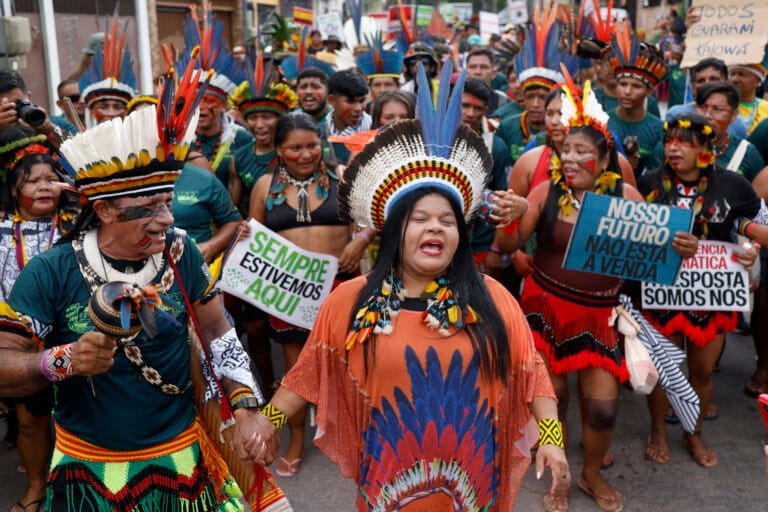
In Brazil's recent Oct. 4 general election, far-right candidates gained significant ground in both houses of Congress. The Articulation of Indigenous Peoples of Brazil (APIB) expressed concern over the results, stating that the outcome is a "bleak moment." Dinamam Tuxá, an executive coordinator with APIB, voiced their disappointment, saying, "We did not expect this result."
The far-right Liberal Party, backing presidential candidate Flávio Bolsonaro, emerged victorious in 19 of the 54 Senate seats up for election, securing 35% of the chamber's 81 seats as of 2027. This substantial increase nearly doubles the party's current representation and gives it the largest bloc in the house. Other right-wing parties, including the Progressistas (PP), Republicanos, and Novo, also performed well, securing a total of 15 seats. This gives the four parties a majority in the Senate.
Center-right parties hold 9 seats, while centrist parties have 13. Left and center-left parties collectively hold 15 seats. The Liberal Party has a history of voting against Indigenous rights between 2019 and 2026, according to an analysis by the Indigenous Missionary Council (CIMI), a Catholic Church-affiliated advocacy organization.
CIMI's analysis reveals that 95.9% of the party's votes were against Indigenous rights. Other right-wing parties followed a similar pattern, with Republicanos at 90.5% and Progressistas (PP) at 85.6%. Novo, on the other hand, cast anti-Indigenous votes 100% of the time.
An election is set for Oct. 25, where Flávio Bolsonaro will face incumbent Luiz Inácio Lula da.
Written by urgent.news from Mongabay's reporting — not their text. Machine-written — may contain errors; check the original before relying on it.