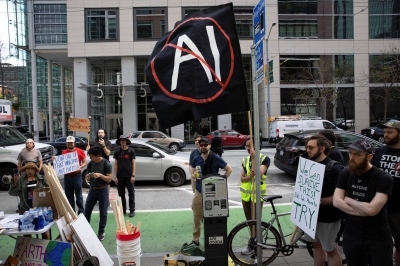
People really hate AI, so why can’t they get enough?
Over the summer I talked to the CEO of Springboards, a startup building an LLM that’s designed to come up with a wider variety of responses than its mainstream rivals do. At the start of the call, he said something that’s been stuck in my head since: “We often say that we’re a self-loathing AI…
Over the summer, I spoke with the CEO of Springboards, a startup developing an AI language model designed to generate a wider range of responses compared to competitors. He expressed a sentiment that has stayed with me: "We often describe ourselves as a self-loathing AI company because we're not sure if we genuinely enjoy what we're doing."
I replied, jokingly, "That makes me a self-loathing AI journalist." While this may sound disheartening, I'm passionate about my career and the technology I cover, which has become riddled with hype, zealotry, and omnipresence.
Public sentiment toward AI is a mix of love and hate. According to the Pew Research Center, a majority of adults in the US believe AI will have negative effects on individuals and society. The sentiment is strongest among younger people. A report by Stanford University found that over half of the world's population feels nervous about AI products and services.
A Gallup poll in May revealed that 71% of US adults would oppose the construction of a new AI data center in their area, compared to 53% who opposed a new nuclear power plant. In an NBC poll in March, AI was less popular than ICE.
Despite this negativity, the usage of AI is rapidly growing. ChatGPT, developed by Springboards, reached one billion monthly users in May, as reported by market analysis firm Sensor Tower. Google DeepMind's Gemini closely followed with 950 million users in July. Half of US adults now use chatbots, more than double the number who did in 2023. One in four people uses AI every day, globally. More than a third of adults across 38 OECD countries have used generative AI tools in the last three months.
These conflicting sentiments raise questions about the nature of AI adoption. Are these two separate groups, or do the numbers suggest a more unified circle? A possible explanation is that as people use AI more, their opinions become more negative. This correlation may be true: AI adoption is highest in the Global North, which tends to be more pessimistic, while AI adoption is lower in the Global South, where people are more optimistic.
I believe the real issue lies in the aggressive push by AI companies to integrate their technology into various aspects of our lives. They often warn of impending social and economic disruptions, which might understandably provoke resistance. In the past, we've experienced similar dynamics with social media platforms like Facebook, Twitter, and Google Search, each facing their own forms of backlash.
Fortunately, there's a glimmer of hope in the current landscape. There's a growing political appetite for regulating AI development and deployment. All 50 US states have either passed or proposed over 2,100 AI-related bills, a tenfold increase from three years ago. Additionally, numerous open-source alternatives to established AI companies like Google, OpenAI, and Anthropic are available, offering some consumer choice and market pressure.
While these changes are not guaranteed, there's still room for hope. The Springboards CEO acknowledged that they were developing a new model despite their reservations about AI, but they emphasized that they could shape the technology differently. Let's hope we see more innovation that acknowledges the limitations of AI and avoids grandiose claims of world domination.
Written by urgent.news from MIT Technology Review's reporting — not their text. Machine-written — may contain errors; check the original before relying on it.