NCSA organises national cybersecurity conference
Under the patronage of His Excellency the Prime Minister and Minister of Foreign Affairs Sheikh Mohammed bin Abdulrahman bin Jassim al-Thani, the National Cyber Security Agency (NCSA) organised the fi...
The National Cyber Security Agency (NCSA) convened the fifth National Cyber Governance and Assurance Affairs (NCGAA) conference on Monday, under the leadership of His Excellency the Minister of Communications and Information Technology Mohammed bin Ali bin Mohammed al-Mannai and NCSA President Eng. Abdulrahman bin Ali al-Farahid al-Malki. Attendees comprised top officials and representatives from government entities and private firms across the country.
The event kicked off with the launch of two pivotal frameworks: the national cybersecurity risk management framework and the institutional cybersecurity risk management framework. NCSA President al-Malki emphasized that safeguarding the digital future is a strategic obligation, extending beyond system protection to ensuring confidence, continuity, and adaptability.
This necessitates a proactive cybersecurity stance driven by innovation, information exchange, and expertise, bolstering national capabilities and fostering public-private sector collaboration.
Al-Malki outlined the importance of achieving cyber resilience, which underpins innovation, growth, and societal trust in digital services and technologies. The NCSA has been dedicated to enhancing national cyber resilience to preempt sophisticated cyber threats, respond effectively, and recover from their impacts, with a focus on service continuity and critical infrastructure maintenance.
Eng. Dana Yousef al-Abdulla, director of National Cyber Governance and Assurance Affairs at the NCSA, highlighted that discussions on securing the digital future encompass more than just protecting systems and data; it's about service continuity, infrastructure protection, digital economic stimulation, and enhancing trust in the digital landscape.
Al-Abdulla stressed that as cyber challenges intensify, especially in critical sectors, convergence among regulatory authorities, critical sectors, and technology providers is crucial for advancing cyber resilience readiness.
The conference unveiled strategic collaborations, including a joint initiative with the Qatar Financial Markets Authority (QFMA) to launch a compliance program tailored for QFMA-regulated entities and the adoption of supplementary controls for national cybersecurity standards. Additionally, the NCSA introduced projects focusing on post-quantum era readiness and the operational technology cybersecurity assessment programme by the International Society of Automation (ISA), aiming to fortify the security of critical sectors and create economic opportunities.
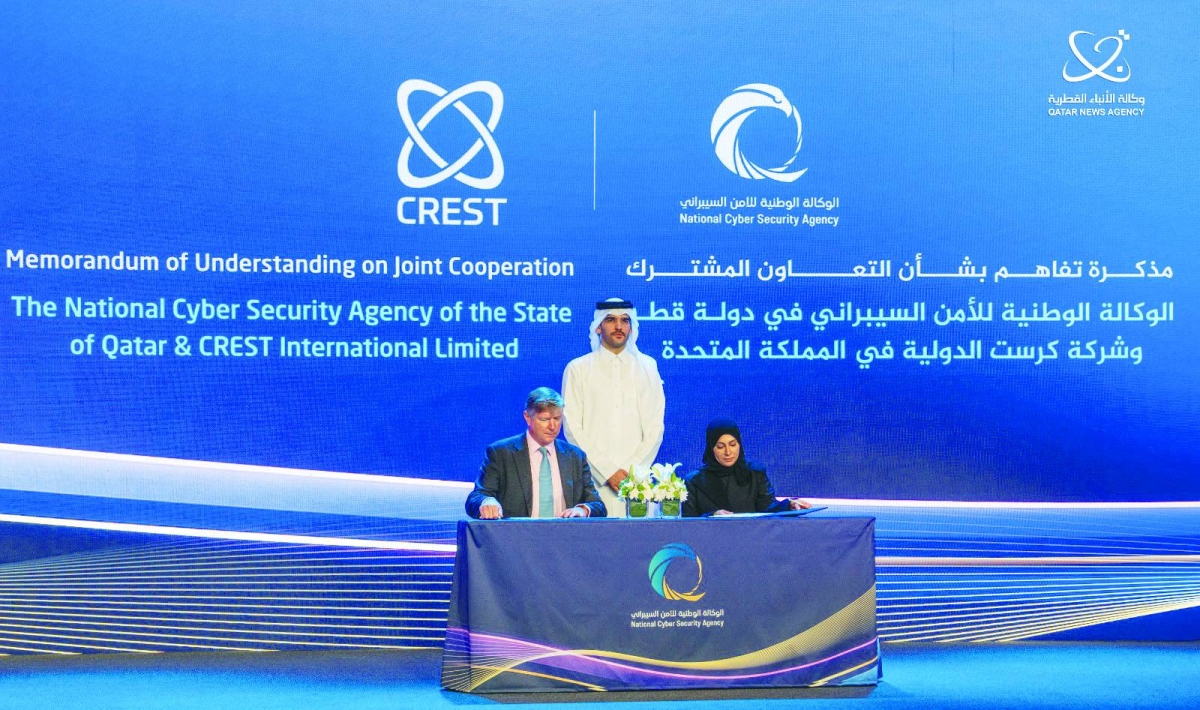
Several accredited and certified companies were recognized for their adherence to the National Information Assurance (NIA) standard and the Qatar Common Criteria Scheme (QCCS). A memorandum of understanding (MoU) was signed between the NCSA and Crest International, aiming to enhance cooperation, elevate cybersecurity standards, and facilitate mutual recognition of accreditation requirements for penetration testing services.
The conference featured insightful panel discussions and presentations by cybersecurity experts, exploring themes such as digital sovereignty in a converging world, readiness for the post-quantum era, regulatory convergence, artificial intelligence risks in operational technology, and the evolving ownership of cybersecurity risk in interconnected environments.
Workshops complemented the conference, covering topics like the national and institutional framework for information security risk management, business opportunities through penetration testing certification, the Qatar NIA standard certification for financial market participants, and the dynamic landscape of data privacy.
Written by urgent.news from Gulf Times's reporting — not their text. Machine-written — may contain errors; check the original before relying on it.