Scientists recreate the universe's first moments and find something they didn't expect
A particle collider experiment just revealed something unexpected about how the fiery soup of particles that filled the universe after the Big Bang coalesced into the protons and neutrons that make up matter today.
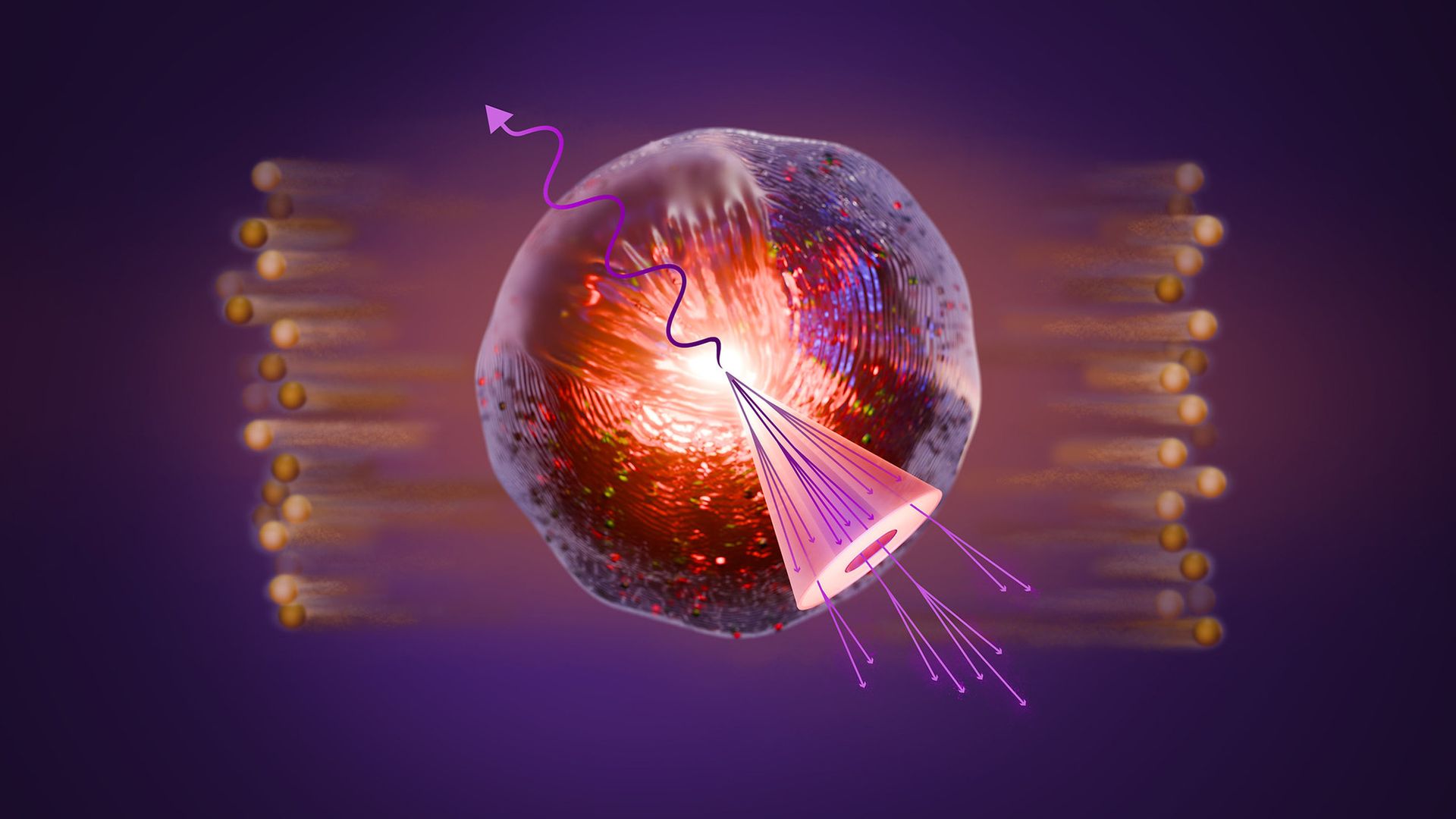
Scientists smashed gold nuclei together at near-light speed, uncovering an unexpected pattern in the particles sprang from these collisions. If validated, this pattern could illuminate how the universe's initial conditions cooled and transformed into protons and neutrons. Typically, particles are dispersed outward; however, physicists found the variability in how forcefully they were ejected to fluctuate unpredictably.
This irregularity might indicate a crucial point, a unique set of circumstances where nuclear matter shifts its transformation from one form to another. Detected by the STAR experiment at the Relativistic Heavy Ion Collider (RHIC) at Brookhaven National Laboratory, the signal is robust but not conclusive evidence of the transition.
The findings, published on September 22 in the Physical Review Letters, highlight the rulebook for extreme matter. Protons and neutrons comprise quarks bound by the strong force via gluons. Under extreme conditions, they form a quark-gluon plasma, believed to have filled the universe shortly after the Big Bang. Understanding the equation of state of nuclear matter, akin to water's boiling and freezing points, could reveal nuclear matter's behavior under extreme conditions like neutron star cores.
The critical point, a potential link between smooth and abrupt transitions, is of cosmological significance as well, as it helps understand the evolution from quarks and gluons to modern-day matter.
Written by urgent.news from Live Science's reporting — not their text. Machine-written — may contain errors; check the original before relying on it.