Radio Emission Detected from Massive Exoplanet Reveals a Magnetic Field Far Stronger Than Earth's
Learn about the first-ever radio signal detected from an exoplanet, a discovery that may have important implications for understanding magnetic fields.
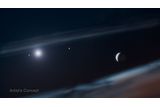
For the first time, scientists have detected a radio emission emanating from a planet beyond our Solar System. This discovery, announced in a preprint paper on arXiv, marks a significant milestone in understanding exoplanets' magnetic fields, which could hold the key to revealing the presence of atmospheres around these distant worlds.
The exoplanet in question, Beta Pictoris b, is a massive gas giant located approximately 63 light-years from Earth. With a mass estimated to be between 9 and 13 times that of Jupiter, Beta Pictoris b is classified as a "super-Jupiter." Such massive planets are considered prime candidates in the quest to identify radio emissions, as they are more likely to possess strong magnetic fields, which in turn increase the likelihood of detecting their radio signals.
The detection of the radio emission from Beta Pictoris b was made possible due to the unique characteristics of its home system. The star Beta Pictoris is relatively young, estimated to be only 21 million years old, and exhibits a magnetically quiet environment. Moreover, Beta Pictoris b is the most massive planet within the system, making it an ideal target for radio signal research.
To pinpoint the source of the radio emission, astronomers utilized the MeerKAT telescope array in South Africa. By observing the Beta Pictoris system on multiple occasions between 2025 and 2026, the researchers were able to identify an auroral radio emission originating from the system. This signal, akin to Earth's Northern Lights, is generated by electrons moving along magnetic field lines.
By determining the precise positions of the star and planets using quasars as reference points, the team successfully traced the radio emission back to Beta Pictoris b.
The strength of Beta Pictoris b's magnetic field has been estimated to be at least 1,250 gauss, a value substantially greater than that of Jupiter's magnetic field, which measures 4.3 gauss, and Earth's magnetic field, which is just around half a gauss. The significance of a strong magnetic field for exoplanets lies in its potential to protect atmospheres from cosmic radiation.
This property could prove crucial in the search for habitable planets beyond our Solar System. While Beta Pictoris b itself does not harbor life, the detection of similar radio emissions from other potentially habitable exoplanets could represent a pivotal step in the broader endeavor to uncover extraterrestrial life.
Written by urgent.news from Discover Magazine's reporting — not their text. Machine-written — may contain errors; check the original before relying on it.