Online claims revive mercury mystery around tomb of first Chinese emperor
Online claims that archaeologists have identified the source of mercury in the mausoleum of Qin Shi Huang – China’s first emperor, who unified the country more than 2,000 years ago – have revived interest in ancient cinnabar sites in northwestern China’s Shaanxi province. The claims, which sent related hashtags trending on social media late last month, centred on three sites in Xunyang where…
Recent online speculation has reignited interest in the mysterious mercury found within the tomb of China's first emperor, Qin Shi Huang, who unified the country over 2,000 years ago. The claims, which trended on social media, point to three ancient cinnabar mining sites in northwestern China's Shaanxi province. Cinnabar, a type of mercury sulfide, was the primary ore used to create mercury in antiquity.
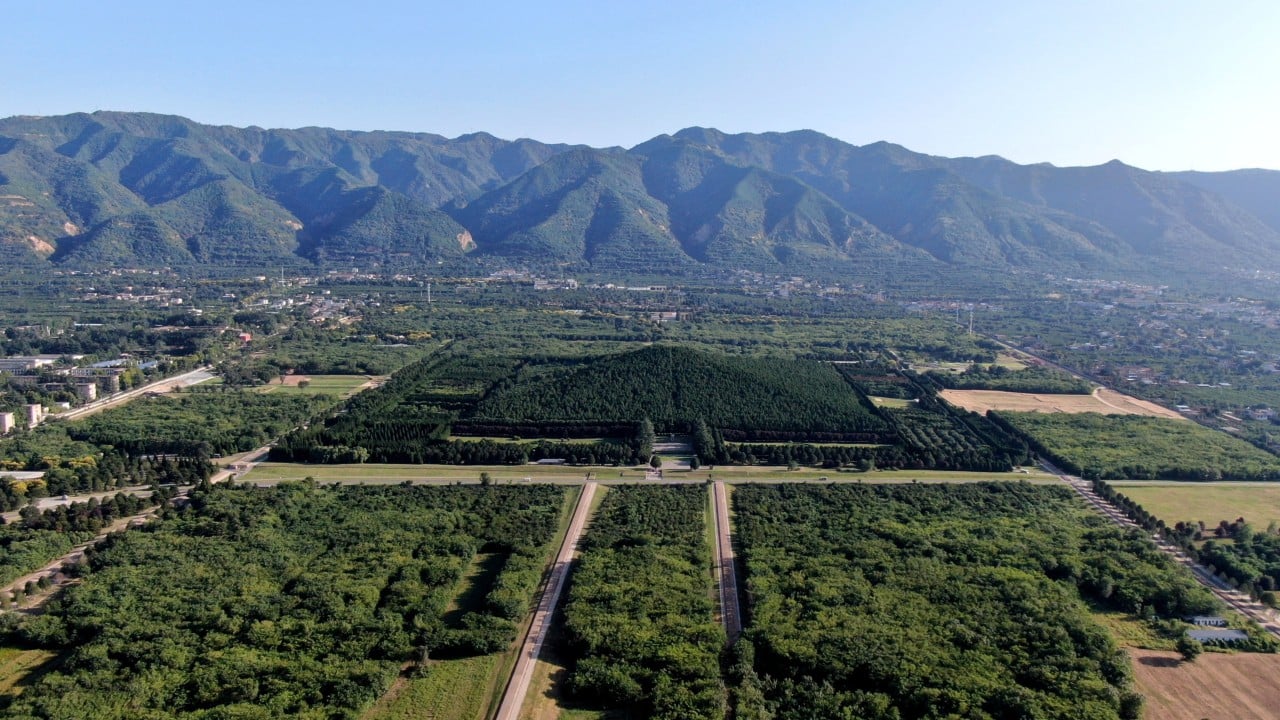
The ancient tomb, located at the northern foot of Lishan Mountain, has never been excavated. Ancient historian Sima Qian, writing in the 2nd century BC, described a vast subterranean realm that mirrored the heavens and the Earth, with mercury used to recreate rivers and seas inside the burial chamber. Cinnabar was the main ore used to produce mercury in ancient times.
The identification of these three cinnabar sites in Xunyang has led to speculation that the region could have supplied some of the mercury described by Sima Qian. However, experts caution against disturbing the tomb's fragile relics. Wu Yongqi, honorary director of the Emperor Qinshihuang's Mausoleum Site Museum, argues that the tomb's underground relics are incredibly delicate and should only be disturbed if necessary for their protection.
He suggests that non-invasive surveys could provide insights into the tomb's contents without disturbing the site.
The mausoleum, built after Qin Shi Huang's unification of China in 221 BC, contains tens of thousands of square meters of burial pits and thousands of statues yet to be unearthed. The complex also includes the famous terracotta warriors discovered in 1974. Archaeologists agree that imperial tombs should not be proactively excavated in China unless specific scientific and technical conditions for relic protection are met.
In 2002 and 2003, Chinese researchers employed remote sensing and geophysical techniques to conduct a non-invasive survey of the mausoleum, revealing the first outline of the underground palace's structure and layout. Wu Yongqi noted that mercury concentrations in the soil above the tomb are more than 70 times higher than in the surrounding ground. While the exact amount of mercury underground remains unknown, the high mercury levels in the soil above the tomb have raised questions about its potential sources.
Despite the emperor's controversial and often brutal rule, his unification efforts are viewed as establishing China's first unified, centralized, multi-ethnic state. The concept of "great unity" continues to influence China's ethnic governance narrative, often cited by President Xi Jinping and scholars as a historical foundation for national cohesion.
Written by urgent.news from Reuters Business via SCMP's reporting — not their text. Machine-written — may contain errors; check the original before relying on it.