Asteroid Bennu Has an Identity Crisis, and Jupiter Might Be to Blame
Asteroid sample return missions have brought well preserved samples of the early solar system (that hadn’t been roasted in a fireball) back to Earth for the first time. But those samples, like the OSIRIS-REx sample from asteroid (101955) Bennu, sometimes provide more questions than answers. A new paper, published in Science Advances from researchers at ETH Zurich and Lawrence Livermore National…
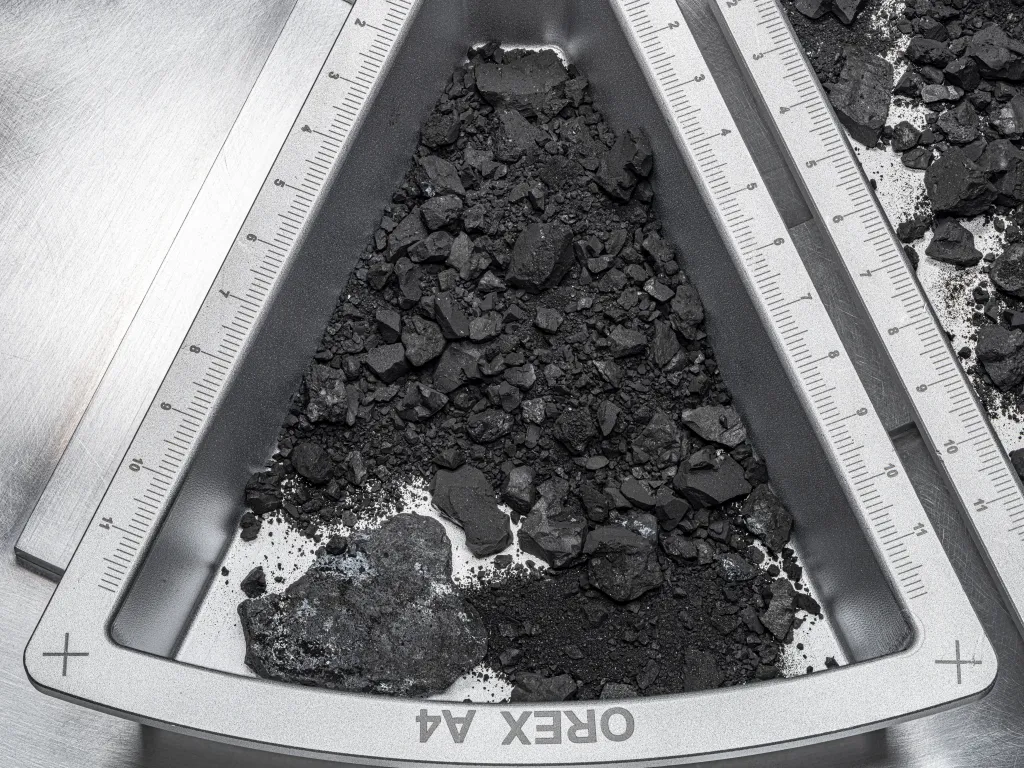
Asteroid Bennu, the target of a successful sample return mission, has puzzled scientists due to its unusual origins. Samples from Bennu, analyzed by researchers at ETH Zurich and Lawrence Livermore National Laboratory, suggest that the asteroid may have formed in both the inner and outer solar systems. This dual origin is evidenced by the presence of certain isotopes in Bennu's material, which align with those found in both inner and outer solar system asteroids.
However, Bennu also lacks the heavy hydrogen and nitrogen typically found in comets, indicating a different formation process. The study proposes that Jupiter's gravitational influence played a significant role in Bennu's formation. During its formation 4.6 billion years ago, Jupiter had already reached a mass 23 times that of Earth, causing it to carve out a path through the protoplanetary disk.
This gravitational force allowed smaller dust grains to migrate inward towards the Sun, while larger, molten droplets called chondrules were trapped in the pressure ridges outside Jupiter's orbit. When these pressure ridges coincided with the water-ice line around Jupiter, the dust began to collapse, forming clumps that eventually became asteroids like Bennu.
The resulting mixture of materials from both the inner and outer solar systems explains Bennu's unique characteristics. Bennu's evolutionary journey, shaped by gravitational interactions and collisions over millions of years, has resulted in a Near Earth Asteroid (NEA) with a dual origin. The discovery provides valuable insights into the early solar system and the processes that shaped the diverse population of asteroids we observe today.
Written by urgent.news from Universe Today's reporting — not their text. Machine-written — may contain errors; check the original before relying on it.