Nach der Berlin-Wahl: Bei Dreiergesprächen noch keine Einigung über Antisemitismus
In Berlin will die Linke mit Grünen und SPD koalieren. Im vertraulichen Vorgespräch ringen die drei Parteien um gemeinsame Positionen zu Antisemitismus und organisierter Kriminalität.
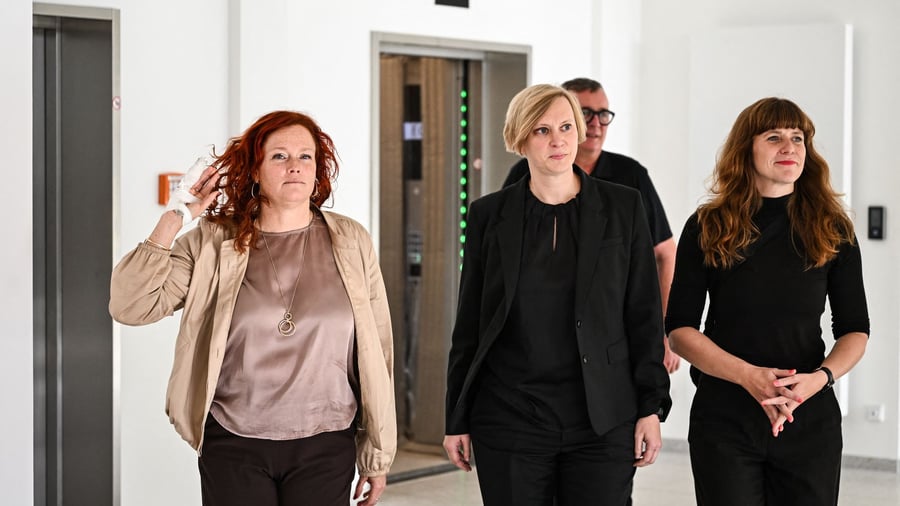
One and a half weeks after the Berlin election, discussions on forming a government in the capital began. Leading politicians from the left, as well as from the Greens and SPD, gathered before starting possible canvassing for a first so-called pre-meeting on the topic of antisemitism. No results were known subsequently. The politicians of the three parties only stated that they wanted to continue the discussion.
When that was planned was initially unclear, but it could be over the weekend. The aim of the first meeting in the trio format was to make arrangements for the recently intensely discussed topic of antisemitism, as well as dealing with racism and organized crime. Such understanding is seen as a prerequisite for the start of canvassing talks.
Background are several incidents involving the left that have alarmed potential coalition partners. No result yet No common line on the sensitive issue appears to be missing. Details of the first "pre-meeting" near Alexanderplatz in the House of Statistics were not disclosed by party leaders Kerstin Wolter (left), Nina Stahr (Green) and Bettina König (SPD) - including not on how exactly things would proceed.
All three journalists present only spoke of a "constructive" exchange. They had agreed on confidentiality. CSU boss Steffen Krach had already assumed on Wednesday that there would not only be a pre-meeting. "For that we need a bit more time." After the first meeting, he said that the second "pre-meeting" was not planned for Friday.
According to reports, it could take place on Saturday, but official information is lacking. The strategy of the three parties is evidently to hold further consultations without waiting journalists in the door and inform only if there is a consensus. The left, after the election, became by far the strongest party. With 25.7 percent, it was clearly ahead of the CDU (18.8 percent), AfD (16.3 percent), Greens (14.3 percent) and SPD (12.1 percent).
The formerly ruling CDU/SPD coalition had thus lost its majority. The left now plans a coalition of red-green-red. If this happens, it could be the first time that a governing mayor of Berlin is elected by the left's top candidate and co-fracture chief Elif Eralp. Debate on antisemitism and clan contacts Recently, there had been a lot of controversy, including a Neukölln left election party on September 20, where a head of an Arab-descended and partially criminal clan as well as a controversial pro-Palestinian activist were present.
He is said to belong to the Popular Front for the Liberation of Palestine (PFLP), which is classified as a terrorist organization by the EU. Neukölln left Bundestag deputy Ferat Koçak meanwhile faces pressure because he exchanged friendly chat messages with a son of a clan-associated large family. He announced on Wednesday that he would be giving up his seat on the Bundestag's Interior Committee as a consequence.
"I am neither criminal nor do I support organized crime," he wrote on X further. Parts of the left in Berlin have been under criticism for their positions on Israel and Palestine and on antisemitism for some time now. The top personnel of the federal association repeatedly assured after the election that the party stood for the protection of Jewish life.
In recent days, the left has also filed lawsuits against politicians from other parties across Germany who had harshly criticized the left and disputed its government capability. Sourcing in the past days there have already been various meetings in pairs format between left, Greens and SPD. In case of any understanding in one or more "pre-meetings", canvassing could start, possibly from next week.
The three parties have already appointed canvassing teams with each three or four top politicians. Canvas talks are not coalition negotiations. Rather, the participants are trying to figure out which points are particularly important to them and whether coalition negotiations would even be worthwhile. Such talks can also fail. The big issue is probably the issue of housing and rent, which played a huge role in the Berlin election campaign.
The left's central demand is the nationalization of large apartment groups in order to gain 220,000 additional apartments in communal hands and more influence on the apartment market. At a referendum, a majority of Berliners voted in 2021 in favor of this. The Greens want to implement the referendum and like the left draft a law for it.
SPD chief Krach declared in the election campaign that there would be no nationalizations under him. A question is where the billion-euro sums would come from to compensate the groups for the nationalizations.
Written by urgent.news from Handelsblatt's reporting — not their text. Machine-written — may contain errors; check the original before relying on it.