53% of In-House Identity Teams Report KYA Incidents or Losses
Companies that keep digital identity verification in-house face a pronounced exposure to adversarial bots and agents: 53% report know-your-agent (KYA) related incidents or losses, compared with 28.8% of firms using a mix of internal and external teams and 24.1% of those relying on external providers. The difference shows that the way identity verification is operated […] The post 53% of In-House…
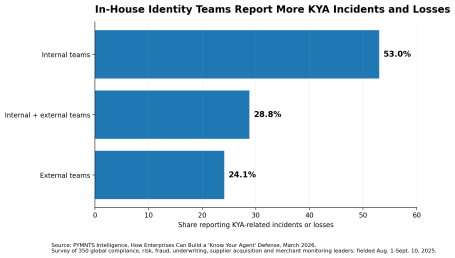
In-house identity verification teams face a significantly higher risk of know-your-agent (KYA) incidents or losses compared to organizations utilizing a mix of internal and external teams or relying solely on external providers. The PYMNTS Intelligence "How Enterprises Can Build a 'Know Your Agent' Defense: Digital Identity Verification in the Age of Bots" study, conducted in partnership with Trulioo, surveyed 350 leaders in compliance, risk management, fraud, underwriting, supplier acquisition, and merchant monitoring at global companies.
The research reveals that 53% of in-house teams experience KYA-related incidents or losses, versus 28.8% for mixed models and 24.1% for external providers. This discrepancy underscores the impact that the method of identity verification implementation can have on both security and associated business costs. A total of 89.5% of surveyed organizations cite managing bot traffic as a challenge, with 52.3% reporting an increase in bot traffic compared to the previous year.
PYMNTS Intelligence identifies three key differentiators in the operating model that shape the KYA problem: in-house teams bear the brunt of KYA losses and customer friction. Internal teams record the highest KYA incident/loss rate at 53%, often relying heavily on manual reviews, with 86.4% employing staff reviews in their verification processes.
This manual approach translates to a 3.3% false-positive rate and significant customer costs, including missed business opportunities due to user abandonment during onboarding, with 61.4% of internally managed programs reporting such instances. While external teams lower some direct KYA risks, they introduce consistency and scalability issues.
Only 24.1% of externally managed programs report KYA-related incidents or losses, boasting a lower false-positive rate of 2.2%. However, 82.8% of these programs face inconsistent results from outsourced technology, and 81% contend that their setup hinders the addition or expansion of customers, markets, and geographies. Hybrid models fall between these extremes, reporting a 28.8% KYA incident/loss rate and a false-positive rate of 2.7%.
They also demonstrate the highest exposure to credential stuffing and account takeover attempts, at 73.1%, and 60.2% report fake account creation during sign-up. The findings do not pinpoint a singular operating model capable of eliminating trade-offs. In-house programs exhibit more direct KYA incidents and onboarding friction, while external programs demonstrate fewer incidents but face challenges in technology consistency and expansion limitations.
Hybrid models mitigate the incident rate compared to in-house methods while still being vulnerable to credential-based attacks. Enterprises must navigate the balance between verification accuracy, automation, and layered controls to prevent identity checks from becoming either a security vulnerability or a barrier for legitimate users.
PYMNTS Intelligence collaborates with businesses to uncover insights that inform intelligent, data-driven discussions on evolving customer expectations, a more interconnected economy, and the strategic adjustments necessary to achieve desired outcomes. Leveraging rigorous research methodologies and a commitment to objective quality, PYMNTS Intelligence provides trusted data to support business growth.
As a partner, one gains access to a diverse team comprising PhDs, researchers, data analysts, number crunchers, subject matter experts, and editorial professionals. The post 53% of In-House Identity Teams Report KYA Incidents or Losses originally appeared on PYMNTS.com.
Written by urgent.news from PYMNTS's reporting — not their text. Machine-written — may contain errors; check the original before relying on it.