Why is the US withdrawing its troops from Iraq?
A US-led coalition deployed in Iraq more than a decade ago to fight jihadists concluded its mission on Wednesday, a move celebrated by the country's leaders, but which some fear will embolden pro-Iran armed factions. France 24's Angela Diffley takes a look at the security challenges facing the country and why the US has chosen this moment to take its troops out.
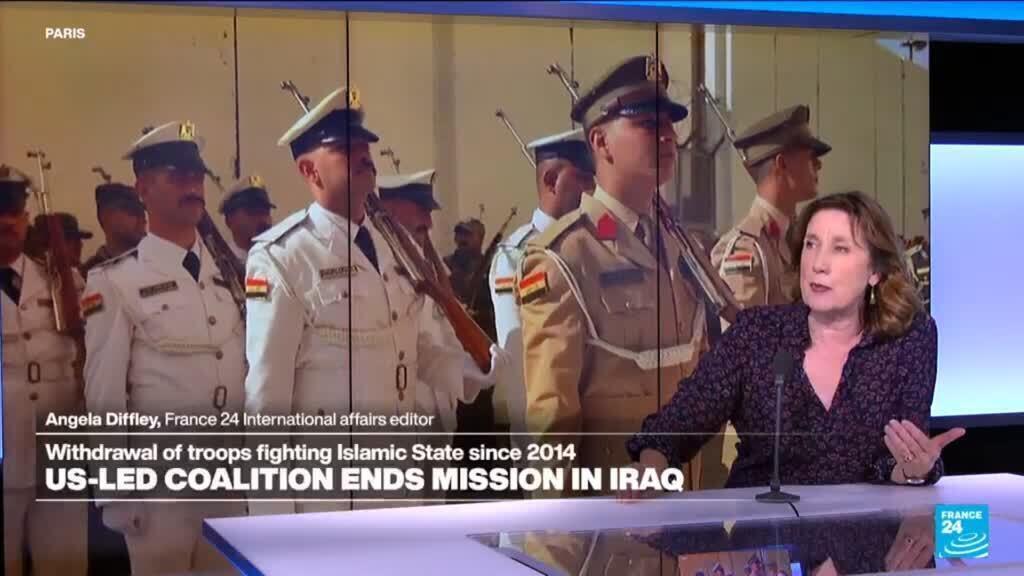
On Wednesday, the U.S. military confirmed the completion of its withdrawal of all American troops from Iraq, concluding a 12-year mission to combat the Islamic State group. The final troops exited an air base in northern Iraq as per a deal between Baghdad and Washington, a pact initially agreed upon two years ago. This withdrawal occurred amidst the ongoing conflict between the U.S. and Iran, which has occasionally escalated into Iraq, with Iran-backed militias targeting U.S. forces and the U.S. responding with strikes against the group's strongholds.
The U.S. had been shifting its focus from the Middle East to Asia in recent years, though this transition has been inconsistent. While some areas saw reduced military presence, others continued to engage in new conflicts. Baghdad's officials hailed the end of U.S. involvement as evidence of Iraq's growing strength and independence.
However, Iran-backed groups welcomed the departure but raised concerns about potential increases in attacks by Iran-linked groups. Critics within Iraq, particularly in the Kurdish region, worry about a resurgence of the Islamic State and heightened threats from Iran's proxies.
Pentagon spokesperson Sean Parnell announced the orderly departure from the air base in Irbil, the region's northern Kurdish area. This move symbolizes a transition from a wartime coalition mission to an Iraqi-led security effort under a more conventional bilateral security arrangement. The U.S. will maintain targeted training and intelligence support for Iraqi allies.
Iraqi Prime Minister Ali al-Zaidi officiated the handover ceremony, emphasizing a new era defined by Iraq's sovereignty, robust institutions, efficient forces, unified decision-making, and balanced partnerships. He stated that Iraqi security forces would continue the fight against ISIS remnants and vowed to prevent non-state groups from acquiring weapons.
The U.S. invasion of Iraq in 2003 aimed to overthrow Saddam Hussein, but a subsequent 2007 pullout was followed by another mission in 2014 to counter the Islamic State's territorial gains. After the extremist group's defeat, Washington and Baghdad signed a deal to withdraw troops in 2024. U.S. forces withdrew from bases across Iraq last year but retained a small contingent in the Kurdish region, which has faced frequent attacks since the U.S.-Iran war began on February 28.
Iraq's government had tied the withdrawal deadline to the disarming of non-state armed groups, but progress has been slow, with powerful militias tied to Iran rejecting disarmament. Al-Zaidi later clarified that the deadline for militia disarming has been postponed to June 2027. The U.S. withdrawal's immediate impact may be modest, given the earlier reduction of its military footprint, yet concerns persist among Iraqi Kurdish officials about the removal of U.S. air defense systems.
Iran-aligned groups in Iraq have also celebrated the U.S. exit, warning that any government not aligned with their interests would face overthrow.
Written by urgent.news from Global News's reporting — not their text. Machine-written — may contain errors; check the original before relying on it.
This story
This is one outlet's version. Read the fullest account.
- U.S. military says the last of its troops in Iraq have withdrawn globalnews.ca
- US military says its withdrawal of troops from Iraq is complete kahawatungu.com
- As US troops leave Iraq, withdrawal carries risks semafor.com
- Mixed reactions in Iraq on final day of US-led coalition withdrawal france24.com
- Baghdad celebrates, Kurds concerned as US completes Iraq withdrawal abc.net.au
- End Of An Era: US completes military withdrawal from Iraq after 12 years israelnationalnews.com