Think lens flare is bad? James Webb Telescope image captures warping light that duplicates galaxies
The newly released photo depicts a galaxy cluster warping the light emitted from more distant galactic bodies, producing what scientists have called “a cosmic house of mirrors”
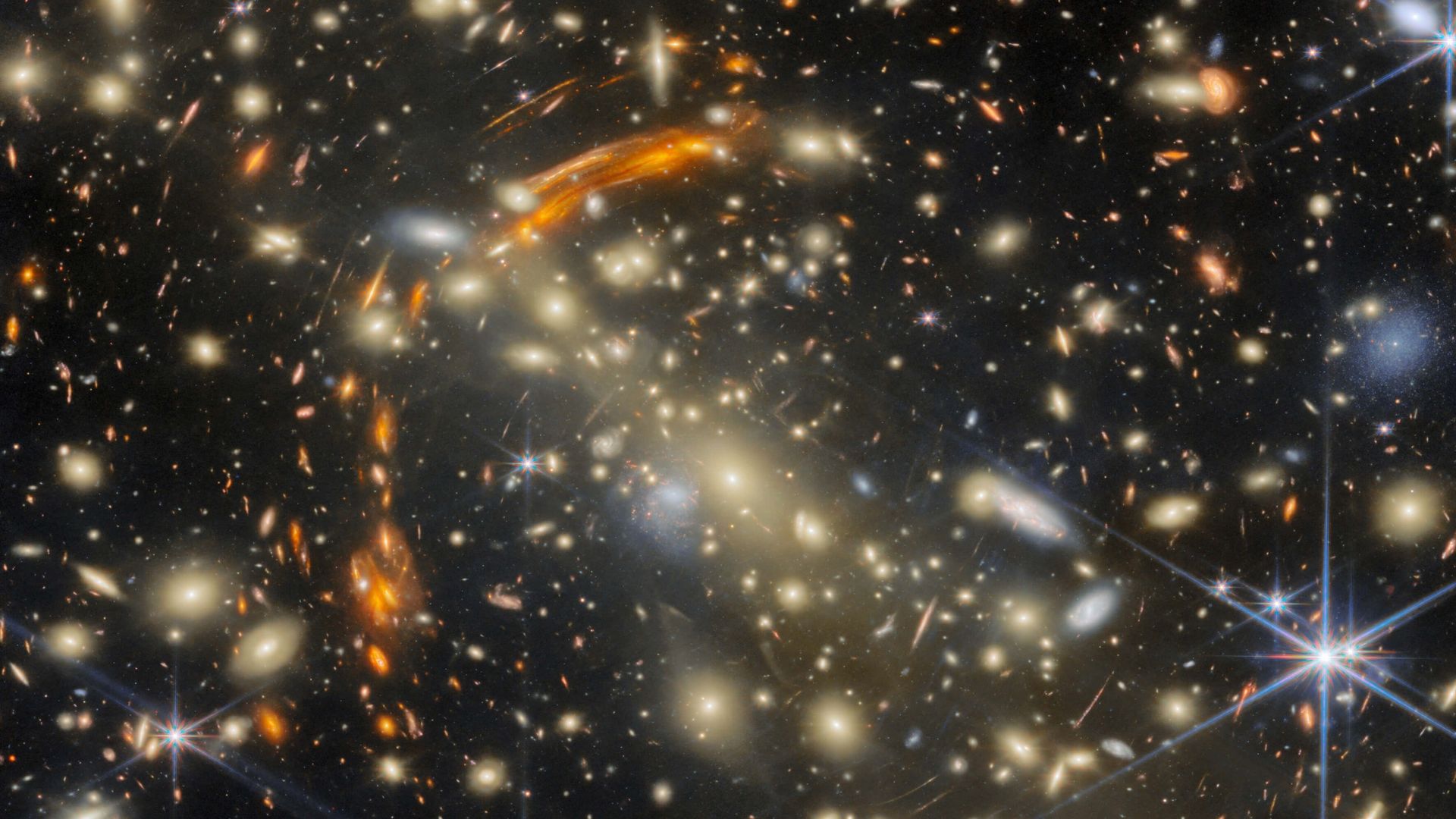
NASA and the European Space Agency (ESA) have unveiled a captivating new image from the James Webb Space Telescope (Webb) showcasing a galaxy cluster warping light from distant cosmic bodies through a phenomenon known as "gravitational lensing." This intriguing occurrence, first predicted by Albert Einstein, unfolds when massive objects such as galaxies bend spacetime, altering and amplifying the light traveling alongside it.
The image, designated as Webb's Picture of the Month for September, features a collection of bright stars in the foreground alongside a galaxy cluster exhibiting a compact group of distorted orange galaxies. According to NASA/ESA, this foreground galaxy cluster, MACS J0454.1-0300, appeared as it was approximately 8 billion years ago to the telescope's instruments.
Meanwhile, the distant orange galaxy cluster, warped and magnified by MACS J0454.1-0300, represents the universe's state around 2 billion years ago – a significantly farther point in space and time from Earth.
Remarkably, some of the distant galaxies subjected to gravitational lensing appear multiple times within the image, creating an optical illusion often termed a "cosmic house of mirrors." These repeated appearances stem from the lens effect, which projects the same image more than once, giving viewers the impression of a closer, densely packed galaxy cluster.
Despite the complexity behind capturing such an image, it serves as a reminder that even seasoned astronomers face challenging subjects when utilizing the Webb telescope.
Written by urgent.news from Digital Camera World's reporting — not their text. Machine-written — may contain errors; check the original before relying on it.
This story
This is one outlet's version. Read the fullest account.