The part Chinese AI could play in predicting extreme weather
AI forecasting is quick and cheap, but errors can’t be tracked and explained, and more data and testing are needed The post The part Chinese AI could play in predicting extreme weather appeared first on Dialogue Earth .
On 9 August, Typhoon White Dolphin made landfall on China’s eastern coast, shattering rainfall records as far inland as Henan province. A weather station in Lushan county recorded over half its annual average rainfall in just 24 hours, triggering flood warnings and halting trains. Such sudden, localized events are notoriously difficult to predict.
In August 2023, a flash flood in the usually arid Yuzhong, Gansu province claimed 32 lives and caused CNY 2.5 billion in damage. The storm developed rapidly over a small area, causing far more intense rain than conventional or AI models had forecast.
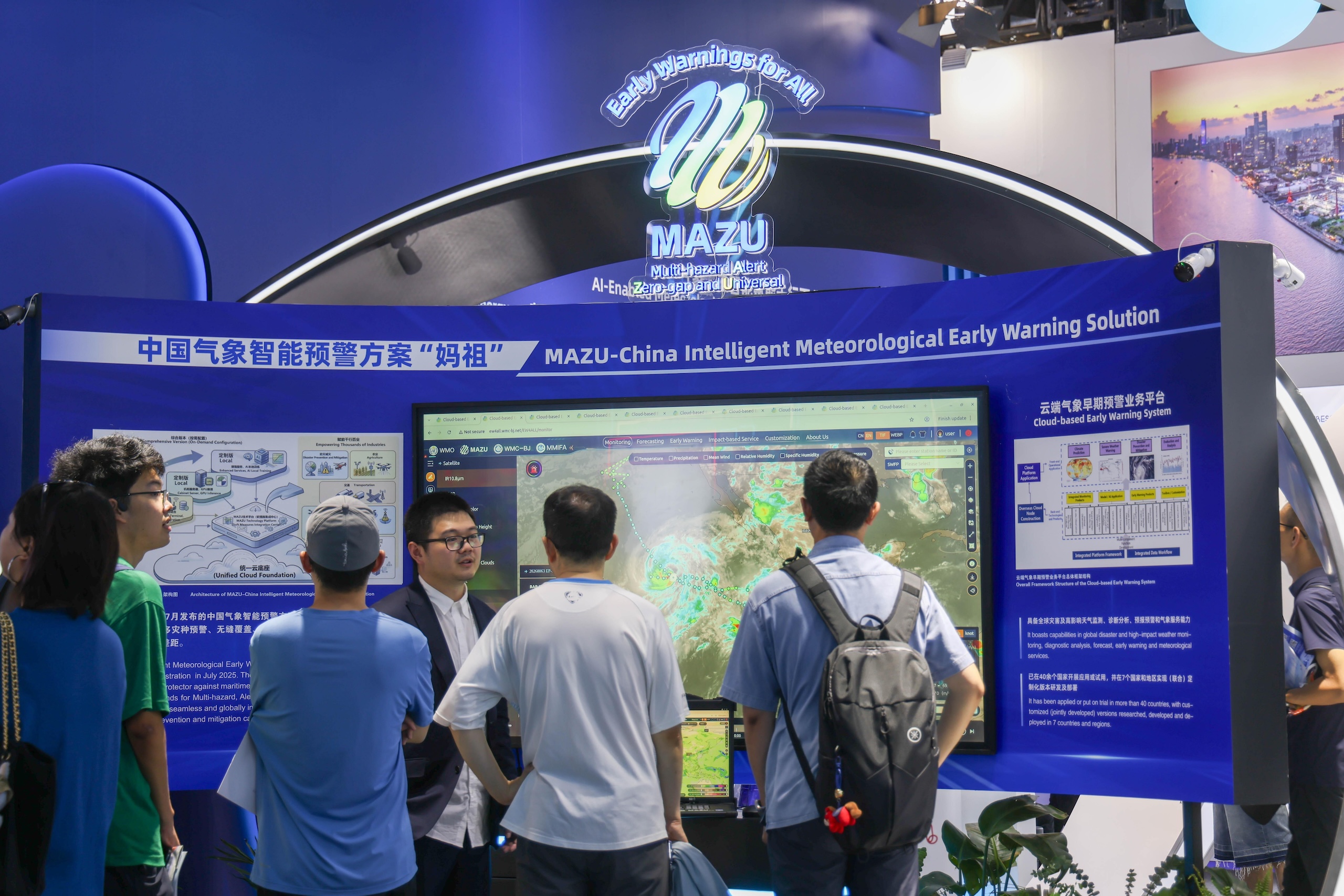
A government report on the disaster noted that accurate predictions would require filling in weather monitoring gaps in remote mountainous areas. There is significant optimism about AI forecasting, which is both cost-effective and swift – an area in which Chinese models appear to be ahead of the curve. Several companies have launched models, and the China Meteorological Administration has an early-warning system, Mazu, utilized in over two dozen countries.
However, concerns persist. How accurately can these models predict extreme weather? What are the risks of relying solely on AI? Is energy consumption a concern?
Dialogue Earth spoke with experts on China's rapid AI weather forecasting surge. Traditional weather forecasting involves numerically solving equations of atmospheric physics, a process that can take several hours even on a supercomputer. In contrast, AI modelling reanalyzes conventional weather forecasting data to make predictions, a process that takes mere minutes and a thousandth of the computational power.
This approach gained traction in China in 2023. In July, the forecasting model Fengniao outperformed conventional models by predicting Typhoon Doksuri's path with an error of just 38.7 km, 24 hours in advance. Fengniao was developed by the Shanghai Artificial Intelligence Laboratory, in collaboration with Xiangfeng Technology, two universities, and the Chinese Academy of Sciences.
Meanwhile, a paper published in Nature detailed the development of Pangu-Weather, a model created by Huawei subsidiary Huawei Cloud. Fuxi, produced by Fudan University and the Shanghai Academy of AI for Science, predicted global weather patterns 15 days in advance with relative accuracy. The Chinese government expanded its involvement in AI forecasting, releasing three models in June 2024 capable of predicting global weather for 60 days within three minutes.
In July 2025, the agency introduced Mazu, a global early warning system that integrates satellite data and AI modelling. Chinese local governments had already begun leveraging AI technology for disaster prediction and mitigation, with Yuan Xingyuan, founder of Colourful Clouds Tech, noting that his company was among the first to work on minute-by-minute precipitation forecasting in 2014.
Initially focused on local forecasts, the technology expanded to provide flash flood early warnings to government authorities, eventually leading to government agencies' reliance on the prediction technology.
Accuracy remains a key challenge. Extreme weather events, such as heatwaves, cold waves, heavy precipitation, drought, tornadoes, and tropical cyclones, are complex systems with limited modelling data. While AI global weather forecasting models perform well in predicting mid-range, large-scale atmospheric circulation and certain extreme temperature events and typhoon paths, they struggle with forecasting typhoon intensity, severe convective weather, and extreme precipitation.
For instance, the Yuzhong flash flood broke multiple records and far exceeded forecasts from both AI and conventional models.
Written by urgent.news from Dialogue Earth's reporting — not their text. Machine-written — may contain errors; check the original before relying on it.