Photographer snapped multiple 1/8000 sec exposures of Venus disappearing behind the Moon to create a “bright pearl” in the sky, winning major astrophotography award
Czech astrophotographer Petr Horalek described the rare lunar occultation of the bright planet as a “beautiful moment”
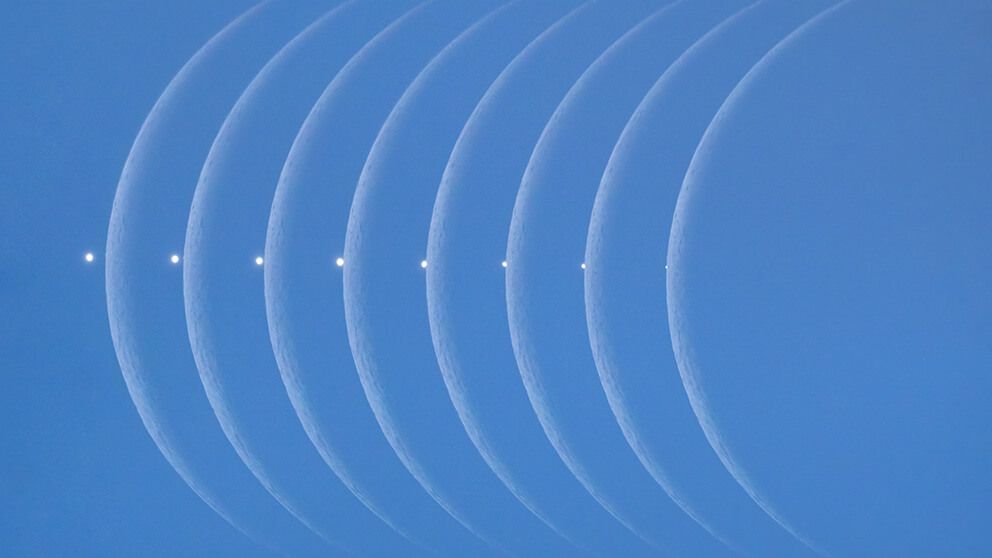
In the 2026 ZWO Astronomy Photographer of the Year competition, Czech astrophotographer Petr Horalek took home the top prize in the "Our Moon" category with a photograph showcasing a rare lunar occultation of Venus. The Moon passed in front of the planet for about an hour during a September afternoon last year, creating the illusion of a "bright pearl" on the lunar horizon. Horalek explained that the most striking moment was when Venus began to disappear behind the crescent.
Horalek captured the unique scene using a Sky-Watcher 10" FlexTube Dobsonian telescope and a Nikon Z6 III, utilizing multiple 1/8000 sec exposures to create the final image. He described finding both the Moon and Venus in the sky as a significant challenge and expressed his gratitude for the perfect weather conditions that allowed him to achieve the desired effect.
Two other notable images were also recognized in the "Our Moon" category. German astrophotographer Raul Cantemir was awarded runner-up in the same category for a detailed close-up of the prominent crater Plato. Cantemir noted that Plato's floor is composed of solidified basalt, indicating ancient volcanic activity.
British photographer Tom Williams was highly commended for his photograph of Pythagoras Crater, another prominent impact crater located on the Moon's northwestern limb. Williams credited a favorable lunar phase for the clear visibility of the central mountainous rise within the crater.
The ZWO Astronomy Photographer of the Year competition is the world's largest astrophotography contest, organized by the Royal Observatory Greenwich in London. This year's overall winner, Ali Alobaidly from Kuwait, captured a rarely photographed image of the Shark Nebula, earning him £10,000 (approximately $13,000 / AU$19,000) and the coveted competition title. Category winners received £1,500 (approximately $2,000 / AU$2,800).
Written by urgent.news from Digital Camera World's reporting — not their text. Machine-written — may contain errors; check the original before relying on it.