Mainland Chinese, Hong Kong stocks face bumpy fourth quarter as risks mount: analysts
Mainland Chinese and Hong Kong stocks may face a challenging fourth quarter as investors contend with underwhelming stimulus measures from Beijing, tighter financial conditions in the US and a shift in the narrative around the artificial intelligence trade, according to analysts. The two markets were likely to consolidate throughout the rest of the year to digest the negatives before settling on…
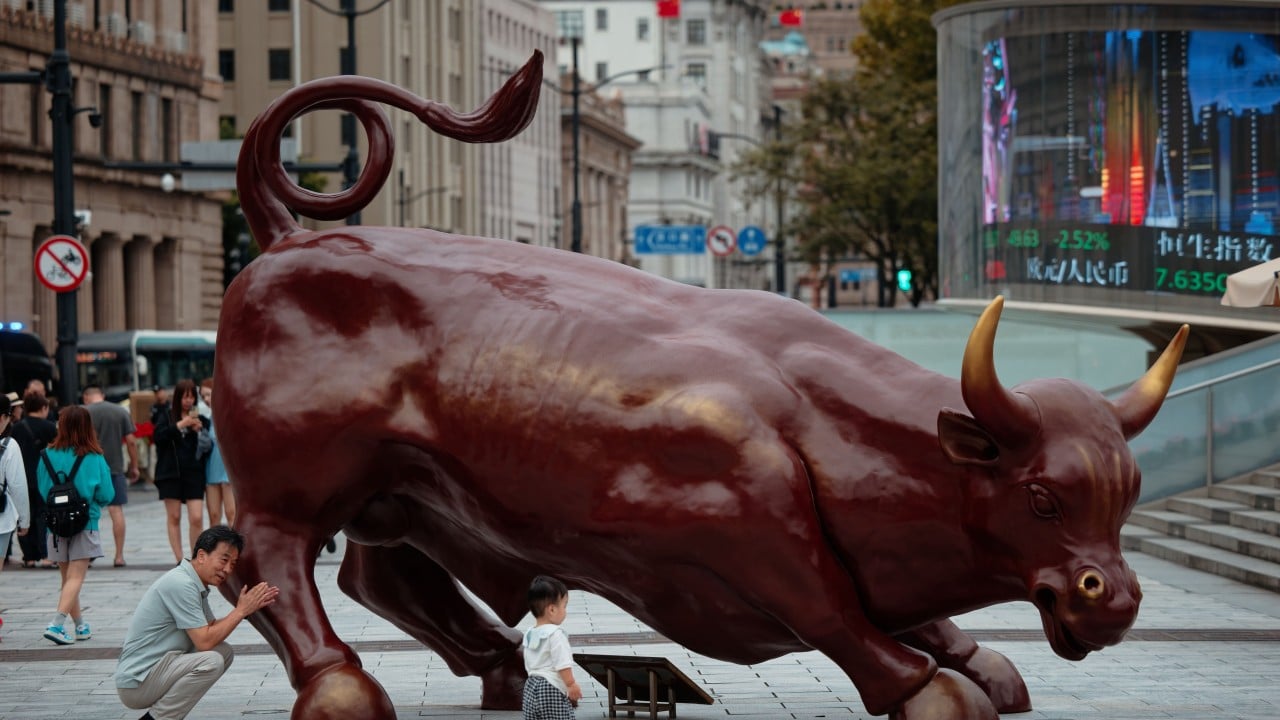
Mainland Chinese and Hong Kong stocks may face a tough fourth quarter, with analysts citing weak stimulus from Beijing, tighter US financial conditions, and a changing outlook on AI as key challenges. The two markets are expected to consolidate to absorb the negatives before settling on a clearer direction. Brokerages such as Zheshang Securities and CCB International anticipate the Hang Seng Index will trade within a narrow range between 22,500 and 26,000 over the next three months, with risks leaning towards the downside.
The benchmark hovered around 24,522.90 at the start of the week. Sentiment towards stocks has been declining as the fourth quarter approaches. US Federal Reserve rate traders now estimate a 47% chance of a quarter-point rate increase in October, pushing up US Treasury yields to multi-year highs. Meanwhile, China's growth targets are failing to meet the lower end of its annual goal.
Beijing's recent measures, including mortgage subsidies and a lending facility expansion, are unlikely to reignite domestic demand. Zheshang Securities analyst Liao Jingchi noted that the markets are in a period of consolidation due to uncertainty surrounding rate hikes, geopolitics, and the AI narrative. China's CSI 300 Index dropped 13% in the third quarter, mostly due to technology stocks' record monthly decline in July.
The Hang Seng Index, however, gained 7.2% thanks to limited exposure to AI-related investments. The S&P 500 rose 2.3% during the same period, while Japan's Nikkei 225 declined 5.3% and South Korea's Kospi fell 19%. Additional risks to equities in the fourth quarter include US and Japan's fiscal strains, and escalating trade tensions between China and the European Union.
Optimists argue that the third-quarter pullback presents an opportunity for growth in technology and commodity companies, with China Asset Management predicting strong earnings for these sectors in the coming season. However, the decline in the CSI 300 to its one-year low can be attributed to investors hedging risks ahead of the National Day "golden week" holiday.
China's manufacturing purchasing managers' index rose to 50.1 in September, indicating expansion. Despite this, Beijing's mortgage subsidy and lower interest rate on pledged supplementary lending measures did not excite investors, as the program mainly benefits low-priced home buyers in non-top-tier cities, where property prices are expected to continue falling.
Written by urgent.news from SCMP Tech's reporting — not their text. Machine-written — may contain errors; check the original before relying on it.
This story
This is one outlet's version. Read the fullest account.
- Mainland Chinese, Hong Kong stocks face bumpy fourth quarter as risks mount: analysts scmp.com
- Hong Kong challenges world's biggest super-prime property market in sales e.vnexpress.net
- Crystal Jade holding companies in S’pore, Hong Kong placed under receivership straitstimes.com
- Hong Kong digital bank WeLab revenue rises 8% in H1 2026 techinasia.com