In Brazil’s Acre, calls for new roads clash with deforestation commitments
Along a freshly repaved stretch of the BR-317 highway in Acre, a Brazilian state bordering Bolivia and Peru in the Western Amazon, pasture stretches out as far as the eye can see. Solitary Brazil nut trees (Bertholletia excelsa), a protected species, are the only reminder of the tropical forest that once stood there. The road […]
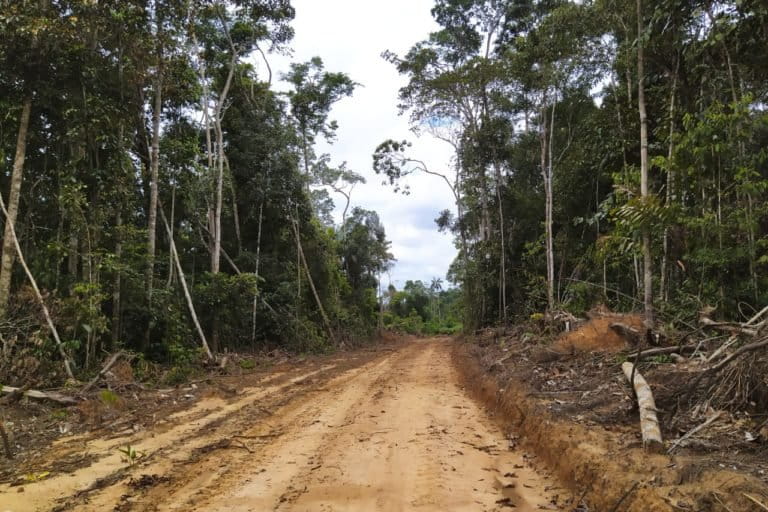
In Acre, Brazil, located between Bolivia and Peru in the Western Amazon, a recently paved section of the BR-317 highway reveals a stark contrast. The expansive pasture, dotted with solitary Brazil nut trees, stands as a reminder of the forest that once covered the land. The highway, part of the Interoceanic Highway connecting the Atlantic and Pacific oceans, inaugurated in 2011, has been linked to deforestation in the Brazilian and Peruvian Amazon.
Sonaira Souza da Silva, a professor at the Federal University of Acre’s Floresta Campus, warns that roads are the main drivers of deforestation and irregular land occupation. Environmentalists fear that plans to build a second road connection with Peru could replicate this scenario across Acre. This follows a renewed push to transform the state into a corridor to the Pacific for exporting Brazilian agricultural and mineral goods, following the 2024 inauguration of the Chinese-built mega-port, Chancay, near Lima.
A recent report by the NGO Amazon Conservation highlights that expanding road infrastructure is incompatible with Acre’s deforestation commitments. If new corridors are constructed, the report estimates that this could result in the loss of between 74,700 to 133,800 hectares, or around 184,600 to 330,600 acres, of forest.
Written by urgent.news from Mongabay's reporting — not their text. Machine-written — may contain errors; check the original before relying on it.