China says Taiwan ‘desecrating the martyrs’ with its WWII history criticism
China's government accused Taiwan of "desecrating the martyrs" with its criticism of Beijing's interpretation of WWII.
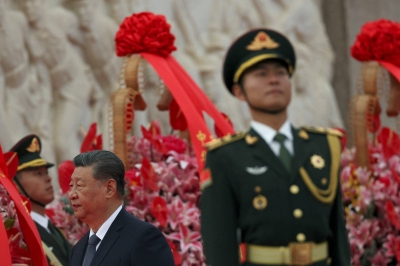
On Wednesday, China's government vehemently criticized Taiwan for its remarks regarding the country's interpretation of World War II history, alleging that such criticism was an offense to the memory of the war's victims and a disservice to the nation. Zhang Han, a spokesperson for China's Taiwan Affairs Office, speaking at a press briefing in Beijing, asserted that Taiwan's Democratic Progressive Party (DPP) was attempting to manipulate the historical narrative, thereby dishonoring the sacrifices of the war's participants and the country as a whole.
China views the conflict, which resulted in the deaths of millions of Chinese citizens during the Japanese occupation, with profound reverence. Both Chinese President Xi Jinping and former U.S. President Donald Trump emphasized the alliance between their nations during the war in recent weeks. However, Taiwan maintains that Beijing is honoring the incorrect China, as the government then in power was the Republic of China, which cooperated with the Allied forces, not the contemporary People's Republic of China.
The Republic of China government relocated to Taiwan in 1949 following their defeat in a civil war, and this remains its official designation. Speaking at the press briefing, Zhang Han emphasized that Taiwan's ruling DPP was attempting to distort the history of World War II, calling it "a betrayal of history, a desecration of the martyrs, and a betrayal of the nation."
Beijing argues that during the war, communist guerrilla forces were the backbone of the Chinese resistance against Japanese forces, and its official historical accounts primarily reference the Republican forces. Zhang claimed that the Kuomintang forces fought Japan on the primary battlefield, while the communists played a crucial role in the "rear battlefields behind enemy lines."
She added that the victory in the War of Resistance was a collective triumph for the entire nation and a significant component of the broader anti-fascist war's victory, deserving joint remembrance and commemoration by citizens on both sides of the Taiwan Strait.
Taiwan was a Japanese colony from 1895 to 1945 and was subsequently handed over to the Republic of China government following the war. The government maintained martial law until 1987. China's victory in the war and its subsequent recovery are considered a shared glory of the Chinese people and the Chinese nation, according to Zhang.
The Democratic Progressive Party traditionally promotes Taiwan's distinct identity and history separate from China, and rejects Beijing's territorial claims. China refuses to engage in diplomatic discussions with Taiwan President Lai Ching-te, referring to him as a "separatist."
Rewritten by urgent.news; may contain errors — check the original.
Source: japantimes.co.jp