Arbeitsmarkt: Flaue Herbstbelebung: Knapp unter drei Millionen Arbeitslose
Im Moment ist die Trendwende nach Jahren der Abwärtsbewegung auf dem Arbeitsmarkt noch nicht in Sicht. Doch die Konjunkturprognose macht zumindest Hoffnung.
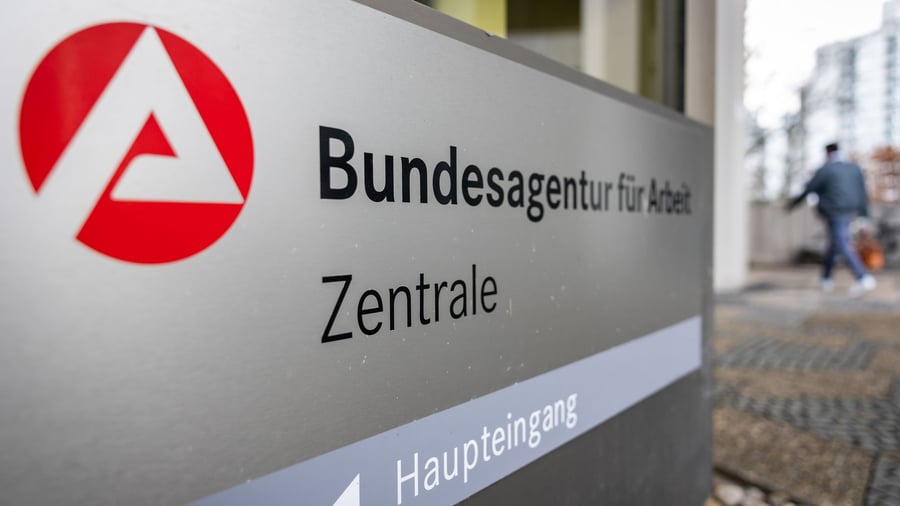
The German economy is showing slow growth, with the signs pointing towards recovery, though the pace is still modest. The question remains: when will this development affect the labor market, when will the trend reversal that almost three million unemployed people have been longing for since more than four years of decline come? Andrea Nahles, chief executive of the Federal Agency for Labor, currently has a cautious response: "Delayed!"
Nahles points out that growth and the labor market are decoupled. "It's a situation we're already familiar with: that the growth of the gross domestic product is somewhat separated from the situation on the labor market," she said. "If we enter into crises, it takes longer for it to manifest itself on the labor market. And when we come out of the crisis, it takes just as long."
The labor market research still does not foresee a trend reversal in the final quarter of 2026. However, "if there is a stable recovery, it will only be a matter of time before it also manifests itself on the labor market," Nahles is confident.
The recent autumn boost was rather mild: the number of unemployed people in Germany fell to under three million in September, down to 2,994,000 from August. The figure rose by 67,000 compared to August, but fell by 40,000 compared to September 2025. The unemployment rate increased by 0.1 point to 6.4 percent compared to August, but was 0.1 point higher compared to September 2025.
The kickoff of the autumn boost was described as "lacking" by Nahles. "The economic improvement is not yet reflected in the labor market," she emphasized.
A further effect is the growing workforce problem: the potential of available workers is decreasing, due to more Baby Boomer individuals retiring, and fewer foreigners coming to Germany. For this reason, Nahles is in favor of increased, but regulated immigration. "We need workers and we definitely need more workers from abroad, especially if the recovery kicks in," she said.
The labor shortage will be a bigger problem in the next five years than the current unemployment situation. The Federal Agency sees the workforce situation critically at the moment. "People are even leaving more than coming in right now."
Currently, the demand for workers in Germany remains weak. In September, 660,000 free positions were reported, 30,000 more than a year earlier. Underemployment, which takes into account free positions, temporary incapacity for work and other instruments of labor market policy, fell in September by 7,000 seasonally adjusted. It was 3,615,000, just 25,000 above the previous year's figure.
In September, 1,082,000 people received basic income unemployment benefits, 85,000 more than a year before. The number of economically active recipients of basic income unemployment insurance was 3,704,000 in September, 145,000 less than a year ago. The highest unemployment rate in Germany is still in the federal state of Bremen at 11.2 percent, followed by Berlin at 10.4 percent.
The southern federal states of Bavaria (4.2 percent) and Baden-Württemberg (4.7 percent) continue to have the lowest rates. Two eastern federal states, Thuringia and Brandenburg, are also below the national average with 6.3 percent each.
Written by urgent.news from Handelsblatt's reporting — not their text. Machine-written — may contain errors; check the original before relying on it.
Also reported by 1 other outlet
- Arbeitsmarkt: Deutsche Arbeitslosenzahl sinkt auf 2,99 Millionen handelsblatt.com