The Evolutionary Raw Deal of the Human Knee
Why don’t great apes have knee problems? The post The Evolutionary Raw Deal of the Human Knee appeared first on Nautilus .
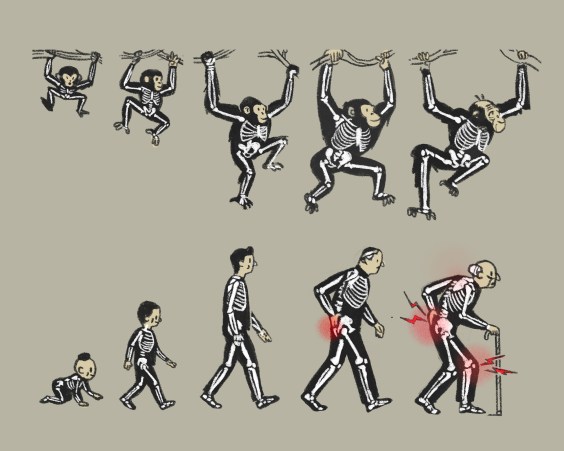
The human knee, a joint that has evolved to support upright walking, is facing a significant evolutionary disadvantage. A new study published in Nature reveals that our knees are less effective at absorbing shocks compared to those of other great apes. This is due to a dramatic shift in the evolutionary process that made our joints less robust, exposing us to a range of skeletal diseases, including osteoarthritis, spinal disc degeneration, and herniated discs.
Researchers from the Weizmann Institute of Science investigated the genetic differences between human and ape knee joints. They discovered that human joints underwent a significant change in gene expression, resulting in less effective shock absorption. The investigation focused on glycosaminoglycans (GAGs), tiny molecules that give cartilage its gel-like structure, allowing it to absorb shocks.
Humans have significantly less GAG production compared to great apes like gorillas, chimps, and orangutans. This reduction in GAG production has led to thinner, less springy cartilage and an increased susceptibility to skeletal disorders.
One possible explanation for this evolutionary quirk is that natural selection favored lighter bones in humans, which could have contributed to our ability to run long distances. Another hypothesis suggests that the reduced GAG production may have made our brains more adaptable, facilitating the development of our complex cognitive abilities. Despite the evolutionary trade-off, the study underscores the unique challenges our knees face as a result of our evolutionary history.
Written by urgent.news from Nautilus's reporting — not their text. Machine-written — may contain errors; check the original before relying on it.