Six Millennium Problems, Two Teams, One Shared Bottleneck
A structural comparison of Six Birds Theory and AIX’s claimed quantum proof pipeline explores certificates, Lean verification, and unproven assumptions.
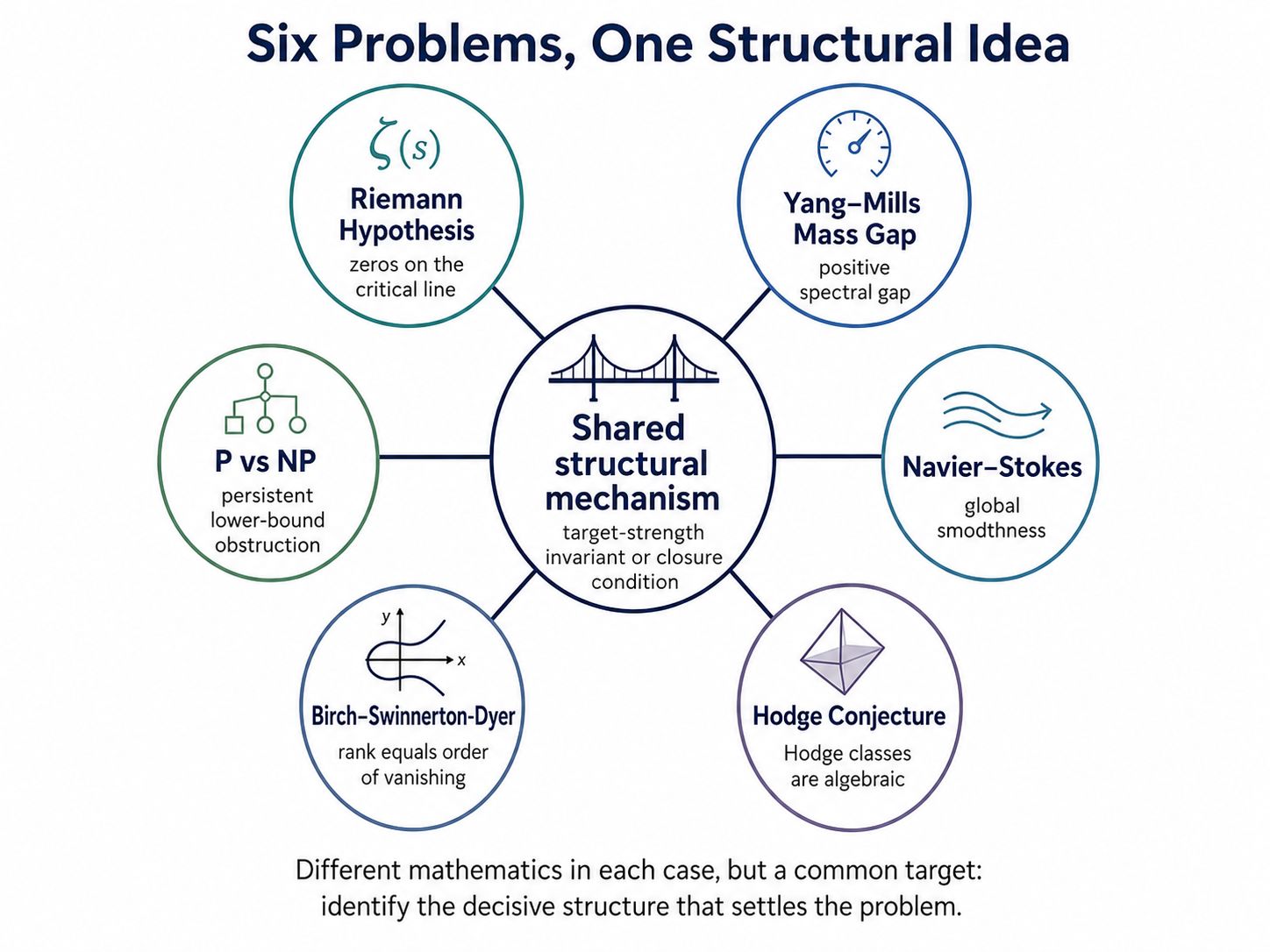
The Six Millennium Problems and Two Teams Converge on a Shared Bottleneck
The quest to solve six of mathematics' most formidable problems with a quantum computer has yielded a fascinating convergence between two seemingly disparate research endeavors. AIX Global's claim of a quantum-computing solution and Denis Ovseyenko and Denise Holt's Six Birds Theory program appear to share a common computational architecture, despite starting from opposite ends.
At the heart of their approach is a unified workflow that identifies problem-specific operators, runs spectral computations, commits certificates, and verifies them using Lean 4. This process, however, raises the intriguing question: what common thread links the Riemann Hypothesis, Yang–Mills, Navier–Stokes, the Hodge Conjecture, Birch–Swinnerton–Dyer conjecture, and P versus NP?
The authors argue that these seemingly disparate problems share a grammar of target, representation, unresolved obstruction, imported content, bridge, and audit. They suggest that both teams independently discovered a computational pipeline that solves each problem through this common architecture.
The source material highlights the potential bottleneck in this approach, likening it to an API boundary in software development. Just as a system's internal optimizations cannot alter the fundamental distinctions exposed by its interface, the quantum computer's architecture may not be able to separate mathematical problems that require different underlying representations or invariants.
One key insight is that a quantum processor does not merely "try all answers at once." Instead, it instantiates a different operational layer with distinct states, observables, dynamics, and encodings. This structural asymmetry allows the quantum machine to expose target-relevant invariants that classical verifiers can use to confirm the solutions, without having to reconstruct the entire hidden structure.
In essence, the two teams may have found the same bottleneck, albeit through different approaches. While AIX Global has taken a more general theory of emergence, Six Birds Theory started from the specific problems and identified the shared computational pipeline. Regardless of the exact path taken, the convergence of these efforts underscores the potential of quantum computing to solve some of mathematics' most challenging questions.
Written by urgent.news from HackerNoon's reporting — not their text. Machine-written — may contain errors; check the original before relying on it.