Repression Around Russia’s Duma Election: What the Data Shows
Denis Shedov, Daniil Beilinson, and Eilish Hart on how the Kremlin used the State Duma election as a disciplinary tool
The 2026 Russian State Duma election has been dubbed the "most corrupt" parliamentary vote in the nation's modern history. According to official results announced on September 25, the ruling United Russia party secured an unprecedented majority, while voter turnout was reported at just under 60 percent. The outcome is more a reflection of the Kremlin's use of repression during wartime Russia than an indication of the population's actual preferences.
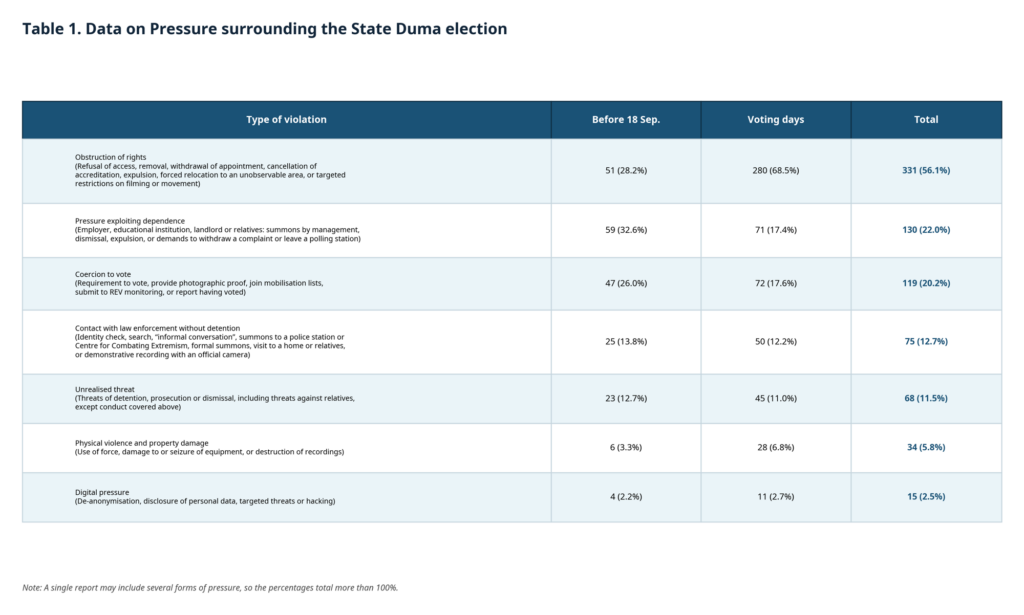
During the crucial voting days of September 18-20, the independent monitoring group OVD-Info documented numerous instances of coercion, election observer pressure, and candidate intimidation. Complementing these findings, data from Elections 2026 revealed 590 reports of administrative pressure and 18 detentions during the voting period.
Notably, these figures are significantly lower than those recorded during previous elections, even in times of conflict. The 2024 presidential vote saw 135 detentions, while the independent monitoring group Golos recorded 1,876 violations. This data also reveals a shift in the political climate. The 2024 election followed a period of increased protest activity following the death of opposition politician Alexei Navalny, but by 2026, Russia had lost a major election watchdog.
Golos was forced to cease operations in 2025 after enduring intense pressure. Despite the election outcome seemingly being predetermined, the Kremlin utilized the vote as a tool for controlling political engagement and excluding opposition forces. Reports indicated coercion, restrictions on monitoring, and refusals to provide paper ballots.
These measures appeared to serve more to maintain control and demonstrate the willingness to deny basic rights than to determine the election's result. The post-election period may still see further repression, as unresolved cases and designations provide the authorities with ample means to intensify pressure. Recently, elections expert Alexander Kynev, a former Golos analyst, was charged with major drug offenses and is currently in a prison hospital.
The pattern of repression observed during the voting period emerged from a series of targeted legal proceedings against political opponents and the physical suppression of dissent. This approach blends formal legal measures, such as the removal of Yabloko from the election and misdemeanor cases against candidates, with physical force, including dispersals of peaceful protests and violence against observers.
The intensity of pressure varied throughout the voting days, peaking on the first day and declining by the third. Reports of voter coercion were highest on the first day but fell significantly by the third. However, encounters with law enforcement, detentions, and physical violence increased each day. Pressure also shifted from voters to observers, whose work exposed electoral violations.
Disputes over filming and the mass exclusion of observers became central issues during the voting period.
Written by urgent.news from Riddle Russia - Politics's reporting — not their text. Machine-written — may contain errors; check the original before relying on it.