Galaxies in a cosmic house of mirrors
Image: This NASA/ESA/CSA James Webb Space Telescope Picture of the Month features galaxies in great detail that have been warped and multiplied like they’ve stepped into a house of mirrors. The brilliant golden galaxies splashed across this image belong to a galaxy cluster called MACS J0454.1-0300. The orange galaxies concentrated on one side of the cluster are not actually part of the cluster…
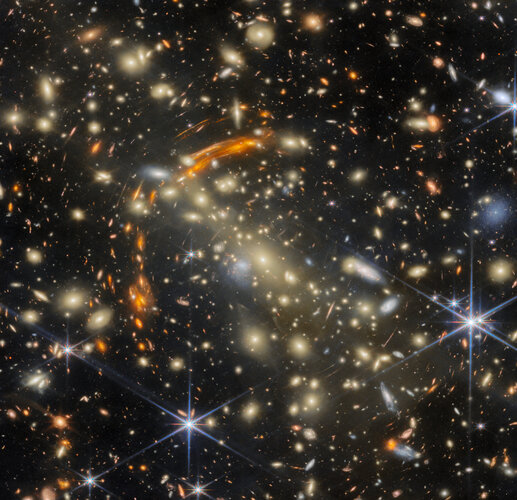
In a spectacular display of cosmic phenomena, NASA's James Webb Space Telescope has captured an image of a galaxy cluster known as MACS J0454.1-0300, revealing a mesmerizing spectacle of distorted and multiplied galaxies. This phenomenon, called gravitational lensing, occurs when the immense mass of a foreground object, like a galaxy cluster, bends and magnifies the light from a more distant background object.
The golden galaxies that dominate the image are part of the galaxy cluster MACS J0454.1-0300, which resides in a distant epoch, roughly 8 billion years ago in the history of the Universe. However, the orange galaxies scattered around the cluster are not members of the cluster itself, but rather galaxies that are much farther away, their light traveling for eons to reach our telescopes.
Gravitational lensing plays a crucial role in this cosmic house of mirrors, allowing astronomers to observe galaxies and celestial bodies that would otherwise be beyond the reach of our telescopes. The image showcases galaxies warped and stretched like a painting that has been smeared by a giant hand, with the gravitational lensing effect creating multiple images of galaxies from a time when the Universe was just 2 billion years old, and even a single galaxy just 800 million years old after the Big Bang.
Interestingly, some of the small reddish background galaxies are also affected by this gravitational lensing, appearing as tiny arcs at the very edges of the frame. These lensed areas contain individual bright 'knots' with sizes as small as 5 light-years, magnified by over 300 times in some cases.
The comparison between this Webb image and a 2014 Hubble Space Telescope image of the same cluster reveals a dramatic difference, with the Webb image exposing hundreds of galaxies that were previously unseen. This enhanced sensitivity to the redder light of these galaxies showcases the power of the James Webb Space Telescope in unveiling the hidden wonders of the universe.
Written by urgent.news from ESA Space Science's reporting — not their text. Machine-written — may contain errors; check the original before relying on it.