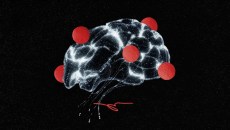
Revisiting the neural correlates of consciousness
Life happens in real time, but experience may be composed in ragtime—like the music genre, full of offbeat notes and uneven rhythms. The assumption that waking life consists of a “stream” of conscious representations has inadvertently led consciousness science to its current impasse.

The article "Revisiting the Neural Correlates of Consciousness" explores the challenges faced by consciousness science in identifying the neural basis of conscious experiences. The prevailing assumption, that consciousness is a continuous stream of representations, has hindered progress in the field. Several factors contribute to this impasse, including conceptual limitations in defining consciousness, imprecise neural measures, and the inherent subjective nature of consciousness.
The author argues that a key issue lies in the assumption that consciousness is a continuous stream of experiences, which has led scientists to design experiments with the aim of determining what neural activity corresponds to the onset of consciousness. This approach, known as the "neural correlates of consciousness" (NCC), has been critiqued for smuggling in the assumption of a stream of consciousness, thereby violating theory-neutrality.
To illustrate the problem, the author presents a hypothetical experiment involving a participant who sees a noisy image, followed by a ghost appearing. The experiment uses EEG recordings to measure neural activity patterns, each occurring a few hundred milliseconds apart. The author questions which neural signature should be interpreted as the moment of conscious perception of the ghost, highlighting the ambiguity in the current approach.
The author then delves into various theories of consciousness, such as Recurrent Processing and Integrated Information, Higher-Order theories, Global Workspace theory, and the "refrigerator light illusion." These theories propose different interpretations of when consciousness becomes active, and how neural activity relates to conscious experiences.
The author suggests that consciousness may consist of multiple mental events, each correlating to different neural events that unfold over time, rather than a single continuous stream.
The article concludes by emphasizing the need to reconsider common sense intuitions about consciousness and explore the possibility that conscious experiences may be composed of multiple heterogeneous neural events. By revisiting this fundamental assumption, consciousness science may be able to overcome its current impasse and make empirical progress in understanding the neural basis of consciousness.
Written by urgent.news from The Transmitter's reporting — not their text. Machine-written — may contain errors; check the original before relying on it.