A Broomstick in a Man's World
In Emily Mae Smith's surreal paintings, a symbol of women’s work becomes a weapon.
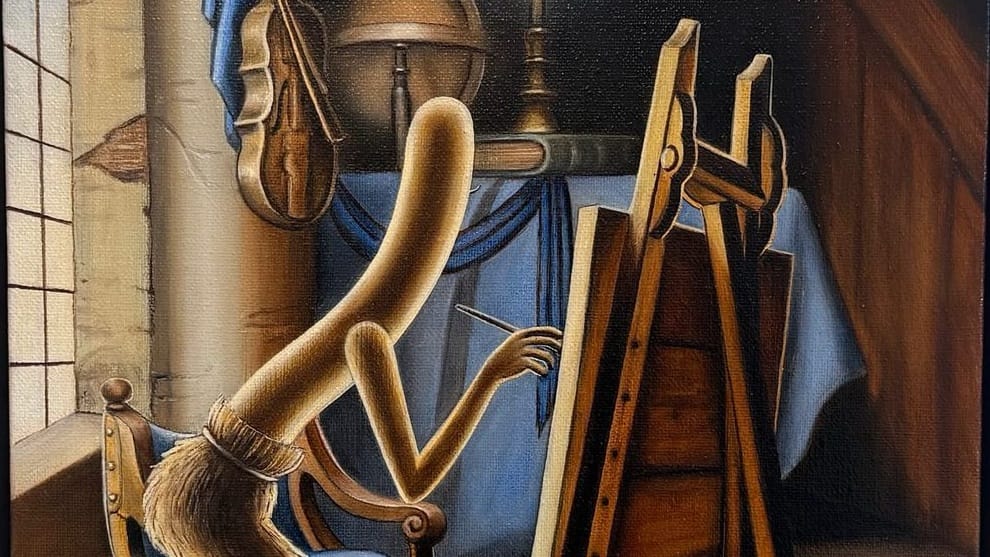
Emily Mae Smith's exhibition, "Transit of Venus" at Petzel Gallery, showcases her unique interpretation of anthropomorphic broomsticks. Her paintings feature voluptuous brooms alongside witch-like bunnies and eyeball-filled grapes, creating a mysterious and haunting atmosphere. The title, "Transit of Venus," refers to the astronomical event when Venus aligns between Earth and the Sun, appearing as a small dark spot. This aligns with Smith's intention to explore themes of translucency and the hidden aspects of her subjects.
One of her notable works, "Venus (Inner Vision)" (2026), depicts a broomstick figure standing in a hazy wooded landscape, with its handle (head and torso) visible through an X-ray. This technique highlights the inner workings of the figure, revealing veins and organs beneath a strong exterior. Smith's intention for transparency and honesty is evident in this piece and others in the exhibition.
Smith's reimagining of historical figures also highlights the multiplicity of perspectives. In "Straw Woman Problem" (2026), she updates the traditionally helpless and demure nude female figure from Jules Joseph Lefebvre's "The Grasshopper" (1872), equipping her with a scythe. Similarly, "Petite Muse at Work" (2026) transforms the male artist-genius figure into a woman.
By casting a broomstick in these roles, Smith gives a familiar gesture a new meaning, turning women's work into a symbol of power. "Transit of Venus" continues at Petzel Gallery (520 West 25th Street, Chelsea, Manhattan) through October 24.
Written by urgent.news from Hyperallergic's reporting — not their text. Machine-written — may contain errors; check the original before relying on it.