Economy, Europe and election - the big issues for Burnham
Andy Burnham's aim is to fix an image in the minds of the British voters that will clearly define Labour in relation to its main challenger - Nigel Farage's Reform UK.
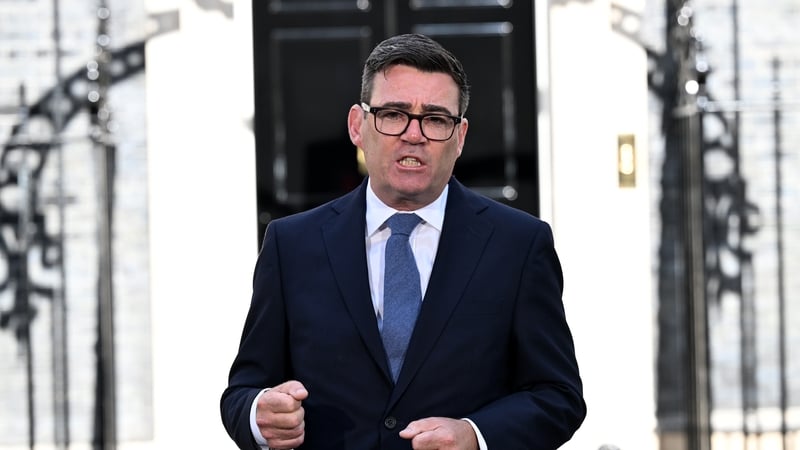
How will the politics of the United Kingdom be influenced by a vehicle known as The Temu Range Rover under Andy Burnham's leadership? The answer is more profound than anticipated. The Labour Party conference commences this weekend, marking Burnham's inaugural speech as party leader and Prime Minister. His subsequent address on Tuesday afternoon will significantly shape the government's identity in the remaining time.
This serves as the latest stage in the party's re-launch, under Burnham's guidance. His primary objective is to shape the perception of British voters, merging ideas, personalities, and sentiments that distinctly define Labour in contrast to its main contender, Nigel Farage’s Reform UK. The three overriding factors are the Economy, Europe, and the Election.
Naturally, every politician contemplates the forthcoming election. Although the British election is not mandated to occur until August 15, 2029, an election at that time would place the Prime Minister at the mercy of unforeseen events. Most prefer a more opportune date, preferably not during the summer break. Boris Johnson chose to call an election three months after replacing Theresa May to secure his mandate for a hard Brexit and to secure a full five-year term.
He secured a commanding majority in autumn 2019 and implemented it for four and a half years. Burnham ascended to the Prime Minister's seat on July 20, 2026, while Johnson did so on July 24, 2019. With the election approaching in late October 2019, Burnham and his party are experiencing a surge in public support. His party has not yet suffered any significant setbacks, and the public remains uncertain about his persona (unlike Keir Starmer, who continues to grapple with a negative public image).
The Conservatives are weak under a new leader focusing on internal recovery, while Reform is a relatively new party, still untested in the political arena. However, Reform is receiving substantial financial support from two crypto-billionaire donors, making it a formidable entity with far more resources than the other parties combined.
If Reform wisely invests these funds over the next couple of years, it could emerge as a powerful challenger by late 2028 or spring 2029. Yet, between now and then, it faces considerable challenges in expanding its parliamentary base. With only eight MPs, Reform would need to field 326 candidates to govern independently, a daunting task.
Even well-established parties, with their extensive resources and professional infrastructure, often find themselves in political turmoil following an election, as miscreants inevitably emerge, gradually diminishing the majority, dignity, and respect of the government. This risk is magnified for an insurgent party like Reform, particularly in a first-past-the-post system where gaining a governing majority is already challenging.
An early election would disadvantage Reform as an organization, as it lacks the necessary experience and infrastructure to field a larger slate of candidates. Similarly, the Conservative Party, still grappling with the aftermath of Brexit and the rise of Reform as a serious contender, benefits from more time to redefine its public image and stabilize under the leadership of Kemi Badenoch.
The defection of MPs, councillors, and supporters to Reform further erodes the Conservative Party's internal cohesion. Consequently, a prolonged period before the election appears advantageous for the Tories. However, the Conservatives face a more pressing threat from Reform, which holds significant strength within Labour's core constituencies.
On Friday evening, Burnham denied to regional TV stations that he was planning an early election, suggesting that 2029 would be the appropriate date. While Burnham emphasized that calling an early election would be self-serving and would preclude the party from delivering on its promises, the polling data suggests otherwise. According to a YouGov Mega Poll published by Sky News, Labour would suffer a significant defeat, losing around 171 MPs but still maintaining the title of the biggest party with 231 seats.
Reform and the Conservatives would be more or less tied with 120 and 130 seats, respectively, but collectively insufficient to form a government. The Liberal Democrats, with 71 MPs, would hold the decisive power in any potential coalition negotiations, and they are unlikely to align with Reform. Even in a hypothetical Liberal Democrat-Labour coalition, the party would still fall short of the necessary seats.
This poll indicates a resurgence for the SNP, securing 40 seats, while Plaid Cymru's support would surge from four to 15 seats. However, given the recent events, their demand for new independence referendums for Scotland and Wales could make them a difficult ally to convince. The poll also reveals a substantial decline in Reform's seat projections from the previous Mega Poll, which placed Reform as the leading party and on track to form the next government.
In terms of vote shares, Sky's poll projected Labour at 24%, Reform at 22%, and the Conservatives at 21%, with the Liberal Democrats at 12%. Given these projections, the most prudent course of action may be to maintain the current majority and observe how events unfold over the next two years.
Written by urgent.news from RTE News's reporting — not their text. Machine-written — may contain errors; check the original before relying on it.