Charcha Time: Is Bhajan Clubbing Bringing Gen Z Closer To Devotion Or Turning Bhakti Into A Trend?
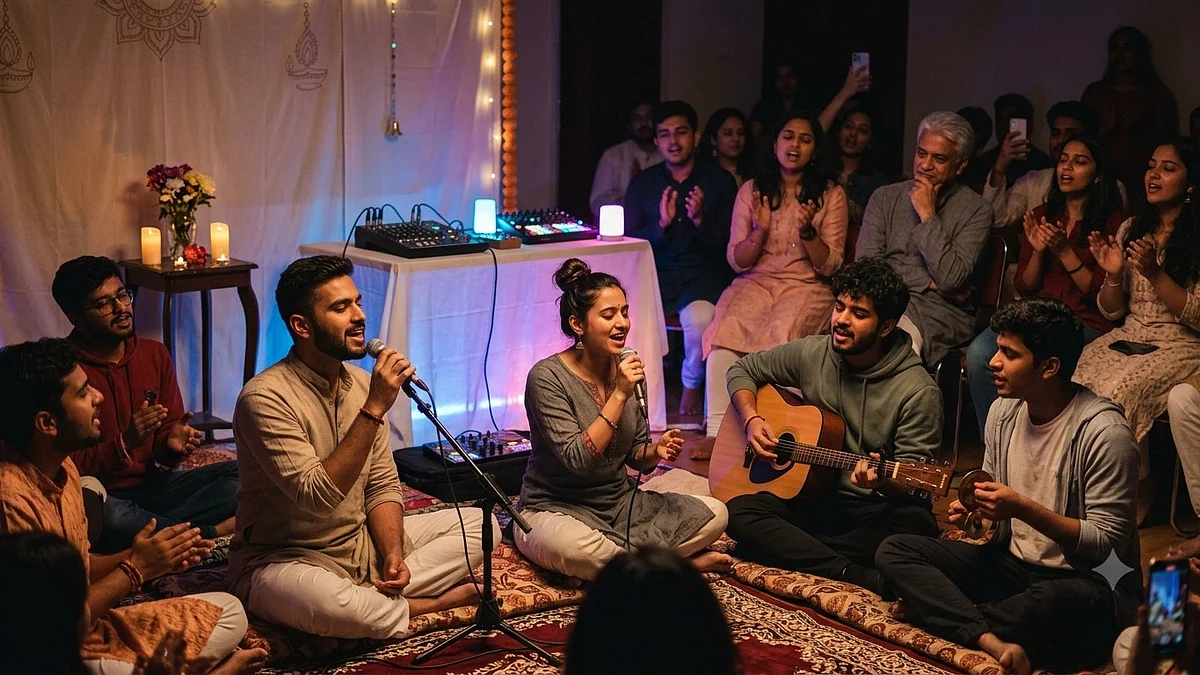
From traditional bhajans to energetic bhajan jamming, devotional music is finding a new audience among Gen Z. While some see it as a refreshing way to make spirituality accessible, others question whether beats, DJs and high-energy settings dilute its essence. Satya Tirtharaj Ghosal moderates a debate. Shashikant Vyas, Founder & Director of Pancham Nishad Modernizing bhajan isn't new…
Charcha Time: Is Bhajan Clubbing Bringing Gen Z Closer To Devotion Or Turning Bhakti Into A Trend?
Traditional devotional music is gaining popularity among Gen Z, with some viewing it as a fresh approach to make spirituality accessible, while others worry that energy-filled settings may dilute its core essence. To address this debate, Satya Tirtharaj Ghosal moderated a discussion featuring Shashikant Vyas, Founder & Director of Pancham Nishad, and Raghujeet Singh, a student in M.A. Music.
Vyas argues that modernizing bhajan isn't a recent commercialization but a long-standing practice, as seen in programs like Bolava Vithal that have run for 16 years. He emphasizes that bhajan, meaning collective devotion, inherently includes group singing. However, he cautions that excitement should not be mistaken for depth, as it largely depends on the performer. He highlights the importance of lyrics and musicianship in devotional music, contrasting it with classical music where raga alone suffices.
Vyas discusses ticket pricing and the commercial aspects of bhajan events, clarifying that most performers are middle-class individuals rather than profiteers. He emphasizes that the primary goal remains spreading culture and promoting a sane mind. For sustainable evolution without gimmicks, he suggests focusing on a clear theme - one deity, one story, curated with intention rather than mixing deities for spectacle.
The younger generation, under more stress than previous ones, is drawn to the rhythmic and calming nature of bhajan jamming, viewing it as a sedative for the mind. Success should not be measured by crowd size but by the spiritual connection people carry home. Bhajan clubbing is just one avenue of spiritual awakening, not the sole method.
Singh, a student in M.A. Music, sees bhajan jamming as a space where Gen Z comes together to sing, chant, and celebrate bhajans with energy, making the bhajans they grew up with feel exciting and relatable. He stresses that the essence of the bhajan always remains the same, with lyrics, emotion, and devotion at its core. The high energy borrowed from club culture is not seen as detrimental, as the rest of the experience remains traditional.
However, he notes that relying too much on electronic beats and equipment might make bhajans feel unnatural, and the balance between modernization and preserving the sanctity of bhajans is crucial. While some may argue that bhajan clubbing turns devotion into a trend, Singh believes that if it helps Gen Z connect with their culture, this connection is likely to persist. For him, spirituality is more about discipline and repetition than shortcuts.
Written by urgent.news from Free Press Journal's reporting — not their text. Machine-written — may contain errors; check the original before relying on it.