TB 26-07 Aluminum Alloy 2219 Material Guidance
For more information, contact Donald S. Parker, Kennedy Space Center, donald.s.parker@nasa.gov Download the PDF version Improper casting and forging processes in the manufacture of aluminum alloy 2219 can lead to microstructural defects that result in a sub-optimal response to anodic surface treatments and an increase in corrosion susceptibility. This Technical Bulletin communicates the risks of…
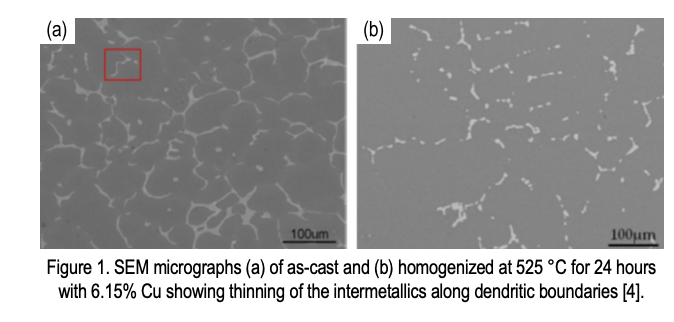
Technical Bulletin TB 26-07 provides guidance on the proper manufacturing of aluminum alloy 2219 to avoid defects that can negatively impact the material's performance. The alloy, developed by Alcoa in 1954, is widely used in aerospace applications due to its excellent cryogenic properties and ability to withstand both high and low temperatures.
However, improper casting and forging processes can introduce microstructural defects, such as disparate grain sizes, macrosegregation of alloying elements, and copper-rich intermetallics, leading to reduced mechanical properties and corrosion susceptibility.
To mitigate these issues, the bulletin recommends a homogenization step followed by multidirectional deformation after conventional direct chill casting, particularly for larger castings. Homogenization involves diffusing copper atoms out of the interdendritic boundary zones, distributing them evenly across aluminum matrix grains, and dissolving residual phases into the matrix. This process dramatically improves the material's mechanical properties and reduces anisotropy.
The optimal homogenization parameters include a temperature of 535 °C and a duration of 10 hours. Researchers have shown that X-ray Diffraction (XRD) or Differential Scanning Calorimetry (DSC) can be valuable tools for verifying the homogenization step. After homogenization, thermomechanical deformation, such as forging and rolling, followed by solution treatment and aging, further enhances the material's microstructure.
This process creates smaller-sized Al2Cu particles and grains, resulting in improved mechanical properties, including increased strength, elongation, and fracture resistance.
In summary, proper manufacturing of aluminum alloy 2219 requires a homogenization step followed by multidirectional deformation to optimize the material's final properties. These processes should be explicitly included in procurement specifications to ensure the production of high-quality, defect-free aluminum 2219 for aerospace applications.
Written by urgent.news from NASA's reporting — not their text. Machine-written — may contain errors; check the original before relying on it.
This story
This is one outlet's version. Read the fullest account.