TB 26-07 Aluminum Alloy 2219 Material Guidance
For more information, contact Donald S. Parker, Kennedy Space Center, donald.s.parker@nasa.gov Download the PDF version Improper casting and forging processes in the manufacture of aluminum alloy 2219 can lead to microstructural defects that result in a sub-optimal response to anodic surface treatments and an increase in corrosion susceptibility. This Technical Bulletin communicates the risks of…
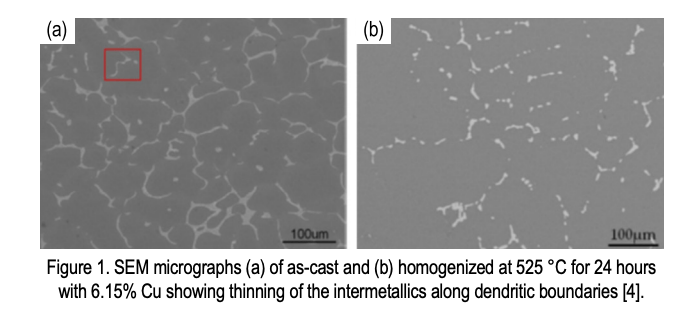
NASA Technical Bulletin TB 26-07 outlines critical guidance for the proper manufacturing of aluminum alloy 2219, a material used in numerous aerospace applications such as fuel tanks and pressurized modules. Improper casting and forging processes can lead to microstructural defects that reduce the material's performance, particularly its corrosion susceptibility following anodic surface treatments.
The bulletin emphasizes that casting 2219 aluminum alloy ingots is a specialized process with potential issues like disparate grain sizes, macrosegregation of alloying elements, and residual banded and clustered copper-rich intermetallics. These defects can result in unsatisfactory mechanical and corrosion properties.
To address these issues, homogenization after conventional direct chill casting is recommended. This process involves using Fick's laws of diffusion to evenly distribute copper atoms throughout the aluminum matrix grains, dissolve residual phases, and reduce segregation of all elements. The optimal homogenization parameters depend on the ingot's cross-section thickness.
Following homogenization, mechanical deformation such as forging and rolling, followed by solution treatment and aging, greatly improves the material's microstructure and mechanical properties. Superior results were observed with a higher temperature multidirectional forging at 510 °C, followed by warm rolling at 240 °C. This process significantly reduced the area fraction of coarse Al2Cu particles and increased the uniformly distributed θ' phase by 118%, leading to better strength, elongation, and fracture properties.
Written by urgent.news from NASA Science's reporting — not their text. Machine-written — may contain errors; check the original before relying on it.