China tested a handheld submarine detector. It tracked a subway train underground
Chinese researchers have showed a handheld quantum magnetometer built for hunting submarines in a striking real-world test: it tracked a subway train rumbling beneath a city street. The device, developed by Peng Xinhua and colleagues at the University of Science and Technology of China, is described in a study published on September 14 in Acta Physica Sinica. Though it is scarcely larger than a…
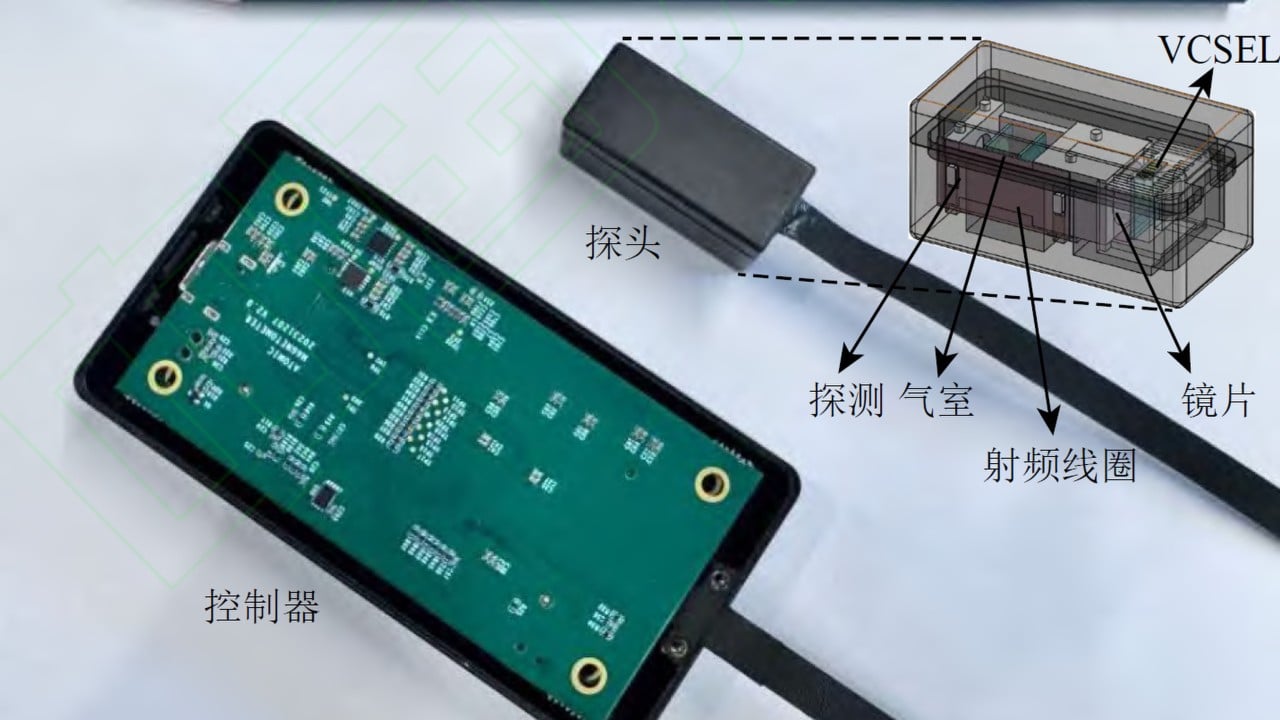
Chinese scientists demonstrated a miniature handheld quantum magnetometer capable of tracking a subway train as it traversed streets underground. Developed by researchers at the University of Science and Technology of China, the device is roughly the size of a pencil and consumes only five watts of power. Despite its small size and low power consumption, the magnetometer can detect the magnetic disturbances caused by the train, clearly recording its braking, stopping, and accelerating under traction.
The magnetometer's primary purpose is anti-submarine warfare (ASW), where it can detect the magnetic anomaly of a submerged vessel. However, its versatility extends to navigation, positioning, field mineral exploration, mine clearance, and urban traffic flow monitoring. The device operates by shining laser light through a cell of rubidium vapor. Changes in the magnetic field affect the rubidium atoms, altering the amount of laser light passing through, which the system measures to calculate the magnetic field strength.
Operating at low frequencies between 0.1 to 10 hertz, the magnetometer exhibits sensitivity of approximately 10 picotesla per square root hertz. Although more sensitive devices exist, such as superconducting quantum interference devices and spin-exchange relaxation-free atomic magnetometers, they require low temperatures or magnetic shielding, making them impractical for use in complex or moving environments.
The Chinese magnetometer is designed to function reliably in real-world scenarios, using an algorithm to monitor and correct potential signal loss or drift due to rapid changes in magnetic fields.
The researchers tested the device in various real-world conditions. It successfully monitored Earth's magnetic field during a G4-level geomagnetic storm, recording data that matched readings from an international observatory network. Additionally, the magnetometer was used to locate a buried magnetic rod in a farmland area, accurately mapping the rod's position in a 2D magnetic map.
The authors also suggested potential uses for the handheld device in urban traffic flow sensing, underground metal pipeline fault diagnosis, resource exploration, and the search for unexploded ordnance.
Written by urgent.news from Reuters Business via SCMP's reporting — not their text. Machine-written — may contain errors; check the original before relying on it.


