India cannot ‘set aside’ international obligations when inconvenient, says Dar on New Delhi’s unilateral move against IWT
Deputy Prime Minister and Foreign Minister Ishaq Dar said on Wednesday that India could not set aside its international obligations when they became inconvenient, stressing that the status of the Indus Waters Treaty (IWT) had been reaffirmed by a court of arbitration. India unilaterally suspended the accord in April last year — a move that was followed by a brief military conflict between the two…
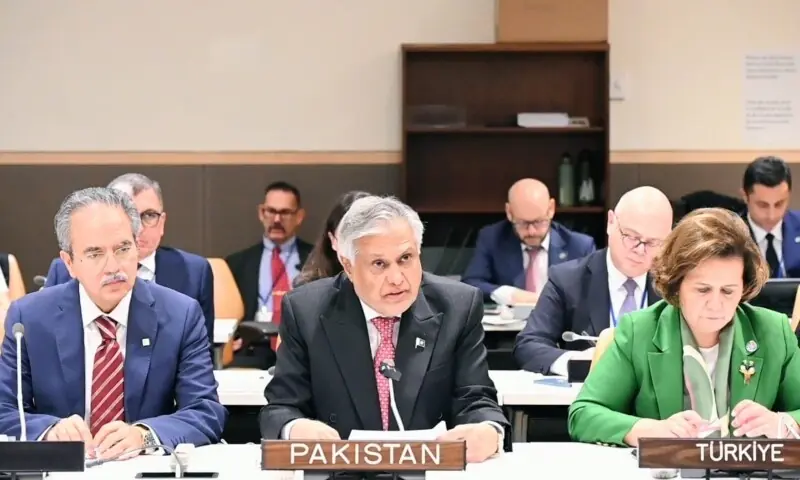
Deputy Prime Minister and Foreign Minister Ishaq Dar cautioned at an Organisation of Islamic Cooperation meeting that India cannot dismiss its international commitments when they are inconvenient. He reminded the audience that the Indus Waters Treaty (IWT) was reaffirmed by a court of arbitration, and India's unilateral suspension of the agreement in April 2025 led to a brief military clash between the two nations.
The Permanent Court of Arbitration (PCA) subsequently ruled that the treaty remained fully in effect, as India had no valid reason to end or suspend it. Dar stressed that international obligations cannot be set aside when they become problematic.
Recalling the May 2025 conflict that followed a deadly attack in occupied Kashmir's Pahalgam, Dar noted that it "provided a stark reminder of the consequences of leaving the Jammu and Kashmir dispute unresolved." He emphasized that India's unilateral attempt to halt the IWT introduced a "dangerous dimension" to the situation, as the treaty is a binding international agreement with no clause permitting unilateral suspension.
The Permanent Court of Arbitration reaffirmed that "the unilateral action by one party cannot deprive the court of its competence and has underscored the continued force of the treaty's obligations, including those governing the Western rivers."
Dar expressed deep appreciation for the OIC's support for the Kashmiri people, who have awaited a UN-sponsored free and impartial plebiscite for almost eight decades. He detailed the series of illegal and unilateral measures taken by India since August 5, 2019, including the suppression of political and civic space in the region.
India has systematically dismantled political and civic space, detaining political leaders, activists, journalists, and youth under draconian laws such as the Public Safety Act. New domicile laws, electoral manipulation, property confiscation, and cultural erasure have been employed to alter the identity of occupied Kashmir.
Dar highlighted the international community's corroboration of these concerns, citing a joint communication by the UN Special Procedures on October 16, 2025, which reported the arrest and detention of around 2,800 individuals, demolition of homes, and blocking of social media accounts. He emphasized that these incidents reveal a sustained effort to silence people, transform the identity of their homeland, and foreclose their right to self-determination and future.
Dar reaffirmed Pakistan's commitment to a just and peaceful resolution of the Kashmir dispute in line with UN Security Council resolutions.
Written by urgent.news from Dawn - Pakistan's reporting — not their text. Machine-written — may contain errors; check the original before relying on it.
This story
This is one outlet's version. Read the fullest account.