India cannot ‘set aside’ international obligations when inconvenient, says Dar on New Delhi’s unilateral move against IWT
Deputy Prime Minister and Foreign Minister Ishaq Dar said on Wednesday that India could not set aside its international obligations when they became inconvenient, stressing that the status of the Indus Waters Treaty (IWT) had been reaffirmed by a court of arbitration. India unilaterally suspended the accord in April last year — a move that was followed by a brief military conflict between the two…
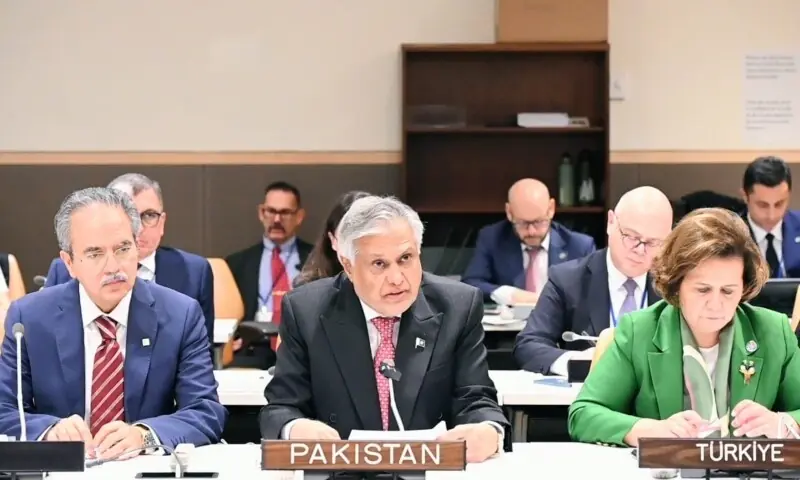
Deputy Prime Minister and Foreign Minister Ishaq Dar, speaking at a meeting of the Organisation of Islamic Cooperation, stressed that India cannot unilaterally disregard its international obligations, such as the Indus Waters Treaty (IWT). The treaty was suspended by India in April last year, leading to a brief military conflict between the two nations in May 2025. However, the Permanent Court of Arbitration recently ruled that the treaty remains in full force, with no basis for India to suspend it.
Dar emphasized that the treaty, a binding international agreement, does not permit unilateral suspension. He reiterated this stance during his address at the ministerial meeting of the OIC Contact Group on Jammu and Kashmir, held on the sidelines of the UN General Assembly in New York. In his address, Dar expressed gratitude to the OIC secretary general and members for their steadfast support for the people of Jammu and Kashmir.
He highlighted the long-standing desire of the Kashmiri people for an international community to honor their right to self-determination through a free and impartial plebiscite under UN auspices. Dar also listed a series of illegal and unilateral measures taken by India since August 5, 2019, aimed at altering the demographic, critical, and cultural character of India-occupied Kashmir.
These measures include detentions, torture, and persecution of political and civic leaders, activists, journalists, and youth under draconian laws like the Public Safety Act.
Dar also pointed out that India has systematically dismantled the political and civic space in the region, outlawing political organizations and criminalizing legitimate dissent. Additionally, India has undertaken various actions to change the identity of the occupied territory, such as introducing new domicile laws, manipulating electoral constituencies, adding non-Kashmiris to electoral roles, confiscating and demolishing properties, and undermining Kashmiri Muslim's cultural and religious heritage.
Written by urgent.news from Dawn - Pakistan's reporting — not their text. Machine-written — may contain errors; check the original before relying on it.
This story
This is one outlet's version. Read the fullest account.