CNA Explains: What does the US-Greenland security deal actually change?
The US, Denmark and Greenland signed a security pact on Tuesday, granting Washington a stronger military presence on the semi-autonomous Danish territory.
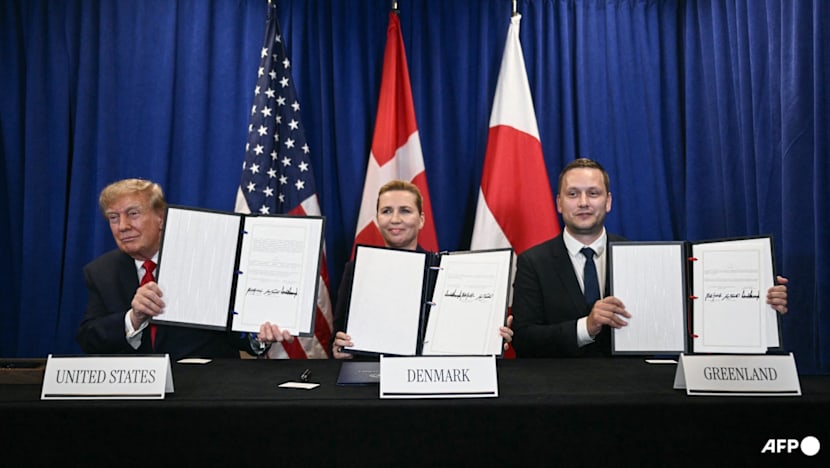
On Tuesday, US President Donald Trump, Danish Prime Minister Mette Frederiksen, and Greenland Prime Minister Jens-Frederik Nielsen signed a security pact that significantly expands the US military presence in Greenland. The agreement allows for the establishment of two new military bases in the country, the deployment of a planned Golden Dome missile defense system, and the prevention of foreign adversaries from gaining military or economic influence on Greenland.
US officials described the agreement as granting permanent control over Greenland's security, but it also reaffirms Denmark's sovereignty and Greenland's right to self-determination. The pact covers two main areas: expanded US military presence and restrictions on foreign investment in Greenland. It permits the US to establish two new military sites in Greenland and grants US forces broad access across the island's territorial waters.
Additionally, it restricts states and investors from non-NATO countries from gaining control or significant influence in sensitive sectors, including critical infrastructure and resource extraction. The agreement has no expiration date and requires approval from the parliaments of Denmark and Greenland. Despite Trump's portrayal of the deal as a major breakthrough, analysts suggest it is more modest, as the US already had extensive military access to Greenland under a 1951 defense agreement that was updated in 2004.
Written by urgent.news from Channel News Asia's reporting — not their text. Machine-written — may contain errors; check the original before relying on it.