Brain Launches The Company Memory That Makes Every AI in The Business Worth Using
Businesses have no shortage of AI tools to choose from. The harder problem is getting those tools to understand the business they are supposed to
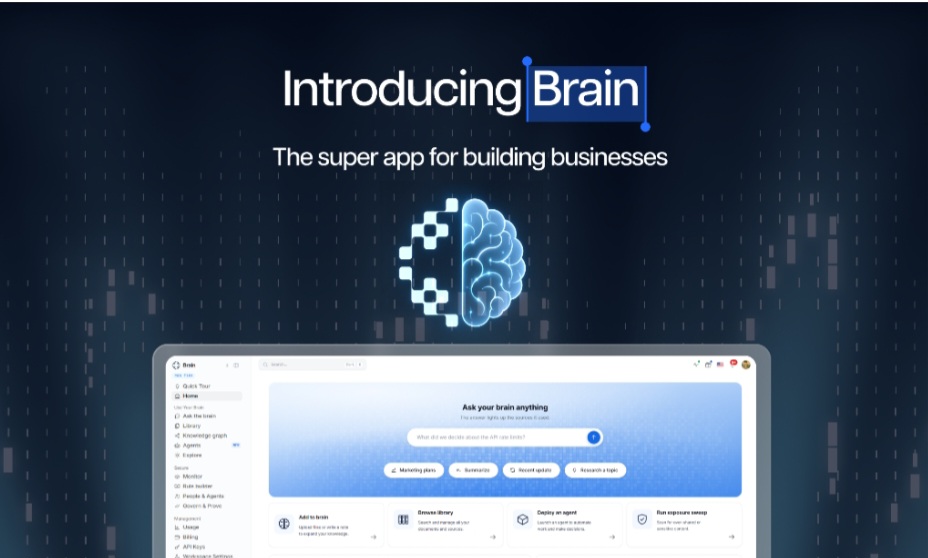
Brain is an AI platform designed to provide businesses with a shared, persistent company memory that enables effective utilization of AI agents. Currently, businesses face the challenge of integrating AI tools that understand the specific business context, leading to fragmented contexts and limited utility. Brain addresses this issue by centralizing persistent memory, company knowledge, AI agents, and governance within a single environment.
At its core, Brain provides a shared knowledge base that is accessible to both people and AI agents. This knowledge base is built by connecting to various sources such as Google Drive, Notion, Slack, GitHub, Box, Telegram, Confluence, Salesforce, and Gmail. By leveraging these sources, Brain constructs a knowledge graph representing the company's documents, people, projects, and relationships among them. As new sources are added, Brain continually refines its understanding of the business's operations.
One of Brain's key advantages is its ability to retrieve information directly from live sources, rather than loading entire documents into a context window. This approach reduces costs and maintains accuracy as the usage grows. When a question is asked, Brain retrieves the relevant passages from the source, providing answers that are directly sourced from the live data.
Brain also offers an API and an MCP (Management Control Plane) endpoint, allowing AI-native companies to access the platform easily. This enables teams to integrate Brain into their systems quickly, typically within an afternoon. The platform deploys AI agents within the app, leveraging the company brain to provide up-to-date information for tasks such as support, sales, and research. Each agent operates within the confines of a governed knowledge base, eliminating the need for manual updates to context files.
Security and governance are critical aspects of Brain's design. Each agent is assigned a unique identity, scope, and mandate, ensuring that they operate within the approved parameters. Actions requiring weightage require human approval, and agents with broad access are subject to stringent oversight. Brain inherits the permissions established by the sources it connects to, preserving the integrity of sensitive information and preventing unauthorized access.
Detailed records are maintained for every access request, including what was withheld, providing an auditable trail for compliance purposes.
By consolidating memory, agents, permissions, and proof into a single platform, Brain simplifies the process of integrating AI into business workflows. It offers a user-friendly self-serve approach, requiring no sales process to get started. Companies can sign up at heybrain.io, connect their sources, and begin querying the system immediately. A live demo is available at heybrain.io/demo, allowing potential users to experience Brain's capabilities firsthand.
Written by urgent.news from HackerNoon's reporting — not their text. Machine-written — may contain errors; check the original before relying on it.