Podcast: The Thompson Ice House
Hey everybody. It is Dylan here and I'm walking through my kitchen and I'm going to do something that I now pretty much take for granted every day. I'm going to walk up to my fridge — I'm holding a glass here — and I'm going to press a little lever and that is ice magically falling out of the fridge into my glass. and then I can put water in it. I still think it's like one of the most luxurious…
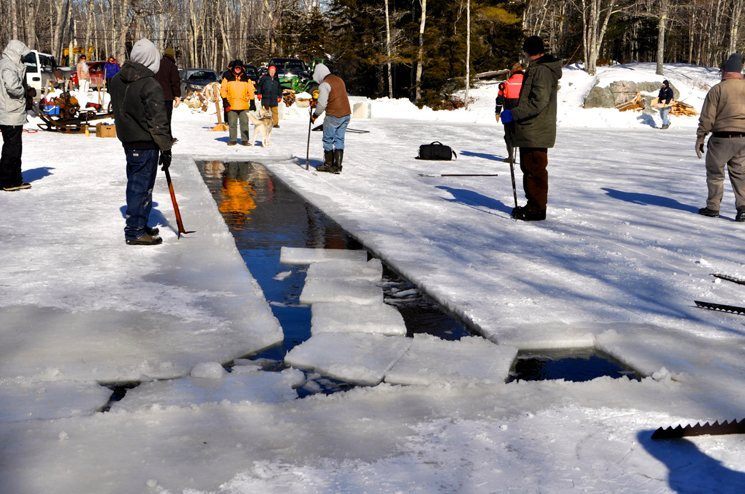
Hey there. I'm Dylan, and I'm going to take you on a walk through my kitchen. You see, I'm holding a glass here and I'm going to press a little lever. In an instant, ice magically falls out of the fridge and into my glass. It's a luxury that seems almost surreal. But back in 100 years ago, getting ice was a far more complex affair. Dozens of people would brave a frozen pond, wielding massive saws and pickaxes to carve out enormous blocks of ice. These blocks were then stored and transported globally.
To understand this better, I'm joined by Dylan Thuras, who is here to celebrate the world's strange, incredible, and wondrous places. Today, we're headed to a small town in South Bristol, Maine, for an old-fashioned ice harvest. Thompson's Ice House is located about 90 minutes north from Portland, Maine and is one of the few places on earth where people still participate in this ancient process.
We are joined by Ken Lincoln, who has lived in Maine his whole life and is essentially the most 'Mainey' Mainer you'll ever meet. Ken has been connected to the ice house since he was around eight or nine years old. The ice house itself is right next to the pond and looks like a small, classic barn with wooden siding and a pointed roof. Every winter, Ken and the entire town of South Bristol come together to open up the ice house, work the tools, and celebrate this tradition that's been frozen in time since 1826.
The ice harvesting process began in the 1800s in South Bristol, Maine, but its roots go much farther back. In 300 BC, Alexander the Great stored ice in pits for year-round availability. Ancient Mesopotamia had records of ice houses, and in third-century Rome, snow was sold at market stalls. Ice and snow were imported from cooler climates and stacked in pits or special buildings packed with straw or sawdust.
The ice harvesting process remained a big business in the 19th century in the United States, with Maine being a prime supplier. In 1826, the first blocks of ice were cut from Thompson Pond in South Bristol, Maine. This ice was used for fishermen, grocery stores, and people's home iceboxes. At one point, New England ice houses supplied ice to Cuba, the West Indies, and beyond. There were even 'ice barons' like Charles W. Morse, who made a fortune betting on the ice trade and shipped ice from Boston all the way to Calcutta.
The ice industry began to decline with the introduction of actual refrigerators in the early 1900s. These mini-fridges started popping up in people's kitchens, and gradually, the ice trade melted away. The Thompson Ice House stayed open for a surprisingly long time, but it officially closed in 1985. However, in 1987, the people of South Bristol realized they had something special on their hands and decided to preserve this piece of history.
Since then, every February, Ken has led a team out to Thompson Pond to cut and stack ice, and, in 2020, I joined them. About 900 people live in South Bristol, and it feels like almost every one of them shows up. Everyone is there to take a step back in time.
Written by urgent.news from Atlas Obscura's reporting — not their text. Machine-written — may contain errors; check the original before relying on it.