Führung und KI: „So einen Abbau hat es in der deutschen Wirtschaft noch nie gegeben“: Das Ende des Managers als Massenberuf
Überall im Land bauen Unternehmen historisch gewachsene Strukturen ab. Das trifft zunehmend gut bezahlte Führungskräfte. Experten warnen: „Das eigentliche Erdbeben kommt erst.“
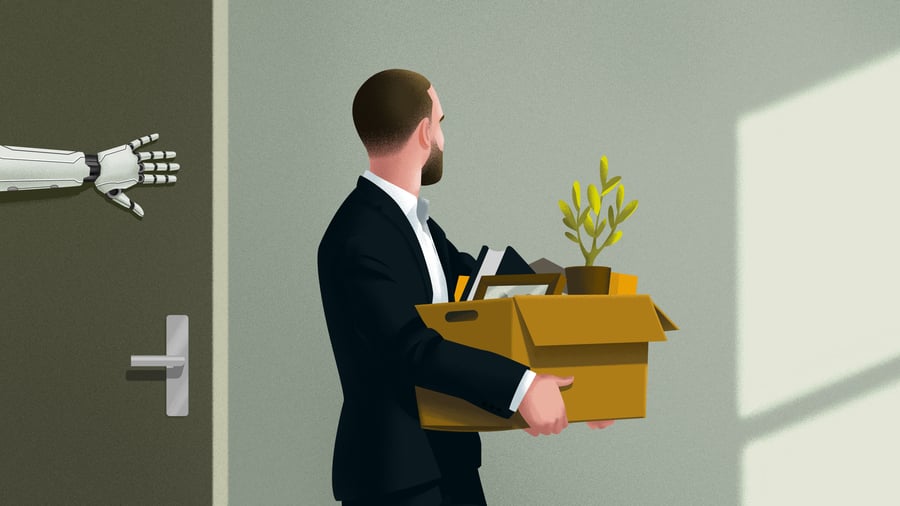
In recent years, many major German corporations, including Volkswagen, Deutsche Bahn, BMW and Bayer, have been reducing their management positions with the aim of streamlining hierarchies and cutting costs. Although this restructuring began long before the advent of Artificial Intelligence (AI), AI is now accelerating the process and increasing the pressure on companies to adapt.
It is expected that middle management will play a central role in managing and implementing AI within their respective organizations. Christine Altstötter-Gleich, a psychologist, discusses the challenges that middle managers may face upon job loss and the impact on their self-esteem in an exclusive interview. The date of September 3rd is significant for Volkswagen, as the supervisory board approved the restructuring plan presented by the management on that day.
This plan entails the removal of over 5,500 management positions by the end of the decade, with the current workforce of approximately 21,500 managers worldwide meaning that nearly one in four positions could be eliminated.
The career progression for managers at Volkswagen was previously predictable: those who performed well rose up the ranks, while those who did not received little recognition. Volkswagen aims to streamline the hierarchy and replace the existing management circles with a new level system that allows for upward mobility. At the same time, management levels are being eliminated and responsibilities are being redistributed.
For those who remain, the pressure will increase as fewer managers are expected to oversee a larger number of employees. The pressure on top executives at Volkswagen will be high, as the company will have fewer managers responsible for more employees.
This restructuring is not unique to Volkswagen. Other major German companies, such as Deutsche Bahn and BMW, are also significantly reducing their workforce, especially in the middle management. Deutsche Bahn plans to eliminate around 30% of management positions, amounting to more than 1,000 employees, including several head positions.
BMW is also planning to reduce personnel in the indirect sector, such as employees working in the company central office or the research and innovation center. Bayer has already completed its restructuring, reducing its workforce by approximately 14,000 positions globally. The management positions have been reduced by two-thirds, from 17,000 to just over 5,000 managers.
The main reasons for the elimination of entire hierarchy levels in German companies are not just structural change and cost pressures. The true threat to the middle management, whose impact is yet to be fully recognized, lies in the technological revolution brought about by Artificial Intelligence. According to Fabiola Gerpott, a Leadership Professor at WHU – Otto Beisheim School of Management, AI is transforming the 'operating system of companies'.
In the future, the question will not be whether AI supports management, but rather why there was ever a belief that humans should make all leadership decisions. Gerpott, who has been researching the impact of AI on organizations and leadership for years, believes that we are only witnessing the tremors of a forthcoming 'earthquake' where AI will not only assist employees but also take on leadership tasks.
At that point, the entire structure of companies will change, and the existing organizational architecture will be obsolete. Michael Brigl, Central Europe Chief of Boston Consulting Group (BCG), also acknowledges that AI is not the sole reason for the elimination of middle management, but it is one of the driving forces behind the trend. Although the second wave of AI is yet to come, its consequences are expected to be significant.
Written by urgent.news from Handelsblatt's reporting — not their text. Machine-written — may contain errors; check the original before relying on it.