Wahl in Mecklenburg-Vorpommern: AfD im Nordosten knapp vor SPD - CDU im Landtag?
Spannendes Rennen an Ostseeküste und Seenplatte: Die AfD liegt laut Prognosen knapp vor der SPD. Die CDU muss um den Verbleib im Parlament zittern. Wer kann am Ende regieren?
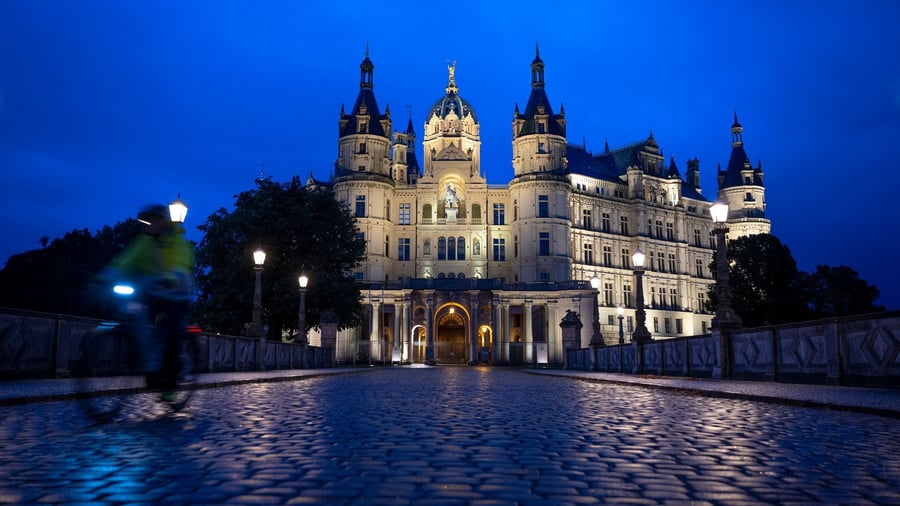
In the Mecklenburg-Vorpommern state election, the SPD has not managed to catch up to the AfD, but Minister-President Manuela Schwesig is expected to continue governing. However, the CDU faces another embarrassment and is now the first time since the founding of the Federal Republic that it has to worry about remaining in the parliament.
The far-left party has lost significant support and could potentially remain in the Landtag and become Schwesig's government partner. The Greens are in a precarious situation, like the CDU, wondering if they will remain in the parliament. The FDP fails to surpass the five percent threshold. The SPD has not quite matched the AfD, but with a campaign specifically targeting a two-front fight, it has not lost much ground compared to five years ago (35.5 to 36.5 percent).
The AfD, led by candidate Leif-Erik Holm, has more than doubled its results (37 to 38 percent), but they lack a partner for government because no party is willing to form a coalition with them. If they end up leading, they would be the strongest force in the third Landtag since Thuringia and Saxony-Anhalt. The CDU is experiencing yet another disaster within two weeks, losing more than half of its votes (5 to 5.5 percent).
Schwesig may need the CDU's support if she cannot rely on the left alone and the Greens end up leaving the parliament. The Linke remains far below expectations at 6 to 7.5 percent. The Greens slip to 5.5 percent (6.3 percent). The FDP flies away with only 1 to 1.2 percent (5.8 percent) and is now only represented in four Landesparlamenten nationwide.
The first-ever BSW struggles to secure a seat, with a prediction of 4.8 to 5 percent. After the post-election surveys by Infratest dimap (ARD) and Forschungsgruppe Wahlen (ZDF), the seat distribution in the Schwerin Castle could look like this: SPD 26 to 28 seats (2021: 34), AfD 27 to 30 (14), Linke 5 to 6 (9), CDU 4 (12), Greens 4 (5).
The majority is expected to be 36 seats according to ZDF. With around 1.3 million eligible voters, including first-time voters aged 16 and 17, voter turnout is predicted at 75.5 percent (70.8 percent). The state results also affect Berlin, increasing pressure on Federal Chancellor Friedrich Merz (CDU). The CDU's party chief received support from the eight CDU Minister Presidents in a joint statement, but the discussion has resurfaced, potentially burdening the coalition.
Despite a convincing victory, Schwesig's government formation may not be easy if it doesn't have enough support from the Linke and the Greens do not remain in the parliament. In this case, Schwesig might need further assistance. The CDU, if represented in the parliament, would likely avoid a coalition including the Linke, as they could not be considered a successor to the East German state party SED.
Therefore, a possible scenario is a right-black minority alliance, cooperating with the Linke on a case-by-case basis. The formation of the government remains limited time-wise - unlike in Saxony-Anhalt. The new Landtag must convene within 30 days of the election and select a government leader within four weeks, by November 17 at the latest.
Failing this, the majority of deputies could decide on the dissolution of the Landtag, leading to a new election or a government leader being chosen with a simple majority on the same day. The polarized campaign between the AfD and SPD has focused solely on who will win: SPD or AfD. The AfD victory in Saxony-Anhalt has intensified this question.
The far-right party advertised with Holm as Minister-President on their posters, while the SPD used Schwesig as "The Woman against Blue." This did not significantly increase support for the non-AfD camp, only redistributing votes towards the SPD. Other parties, however, failed to make a significant impact. The primary issues were education policy, with the AfD announcing the termination of the broadcasting agreement contract in government, and the controversial federal government reform course.
Schwesig countered these issues with sharp distancing from the Berlin coalition, which included her party, and attacked the unpopular federal government's plans for stabilizing pension and care insurance, demanded relief from high fuel prices, and specifically criticized Chancellor Merz. During townhall meetings, she presented herself as a compassionate regional mother, garnering sympathy ratings roughly double that of the AfD challenger.
The AfD capitalized on the concerns of many people facing global crises and the desire for simple and rapid solutions, benefiting from the social discontent in the region.
Written by urgent.news from Handelsblatt's reporting — not their text. Machine-written — may contain errors; check the original before relying on it.