Landtagswahlen: Wahlen in zwei Bundesländern – Wegweiser in der Merz-Krise?
Wer wird stärkste Kraft in Berlin - wieder die CDU oder erstmals die Linke? Und kann die SPD die AfD in Mecklenburg-Vorpommern noch hinter sich lassen? Die Entscheidungen haben Folgen auch im Bund.
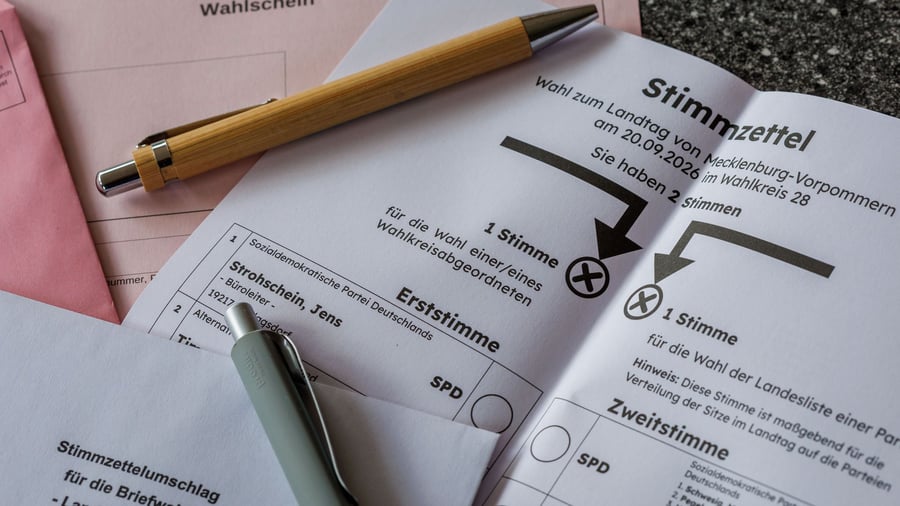
Two weeks after the AfD's victory in Saxony-Anhalt, attention turns to Mecklenburg-Vorpommern and Berlin, where new state parliaments are being elected today. The results are expected to be decisive for the future of the red-black coalition at the federal level. For a long time, there had been speculation about whether Chancellor Friedrich Merz (CDU) could remain in office for long – even within his own party.
The situation is as follows: In Berlin, the coalition of CDU and SPD, which has been in power since 2023, is likely to lose its majority. Surveys suggest that only a three-way coalition can form a majority: either the CDU could join forces with SPD and Greens, or the Left could merge with SPD and Greens. The crucial factor is who will be the strongest party in the new parliament and could claim the right to the office of Regierender Bürgermeister – again, the CDU or for the first time, the Left?
The CDU and Left rank between 20 and 23 percent in recent polls, in different orders. Just behind them come the AfD and Greens. The SPD, which has been co-governing in Berlin since 1989, can hope to place only fifth, with 10 to 15 percent. The election is open to 2.5 million citizens. For the first time, 16- and 17-year-olds are allowed to vote.
Two local polling stations and 1,572 mail-in polling stations are planned. Up to 40,000 election workers are on duty. The CDU replaced its governing Mayor Kai Wegner with Finance Minister Stefan Evers as the new chief candidate after new revelations of false statements about Wegner's crisis management during a major power outage in January.
For the Left, 45-year-old lawyer Elif Eralp would run for the city hall if her party emerges as the strongest. She promised to stop "rent gouging" and to socialize around 220,000 apartments currently owned by large real estate companies. In the campaign, she had to deal with accusations that her party had many openly anti-Semitic activists.
In the election campaign, she had to contend with claims that her party now had many openly anti-Semitic activists. In Mecklenburg-Vorpommern, the campaign was dominated by the duel between AfD and SPD. The SPD, led by Minister-President Manuela Schwesig, has been rising in the polls in recent weeks. For the first time, AfD had been behind SPD in the polls, until the SPD overtook them in the latest poll before the election.
In recent surveys, the AfD was between 36 and 38 percent, while the SPD was between 33 and 37 percent. After the AfD's victory in Saxony-Anhalt two weeks ago, Schwesig once again campaigned against "Die Frau gegen Blau" and appealed to Leif-Erik Holm as the next Minister-President. His party proudly advocates him as the next Minister-President.
Should the AfD emerge as the strongest party, it would not have a realistic option for power. The parties that have represented Mecklenburg-Vorpommern in the state parliament previously excluded a coalition with the AfD before the election. Polls suggest that the Greens could come close to the AfD this time, with around 5 percent.
The CDU has lost much ground in recent months, ending up at around 7 percent. The BSW was found in most surveys below the five-percent threshold. Around 1.3 million people are eligible to vote in Mecklenburg-Vorpommern. They must have a German passport and have been registered in the state for at least 37 days. This year, 16-year-olds are allowed to vote.
Polling stations are open from 8:00 AM to 6:00 PM, with preliminary results expected by 7:00 PM. The provisional result is expected after 11:00 PM.
Written by urgent.news from Handelsblatt's reporting — not their text. Machine-written — may contain errors; check the original before relying on it.