An Indian woman phytochemist without parallel
Asima Chatterjee pioneered research on medicinal plants and plant-derived drugs, while breaking barriers for women in Indian science
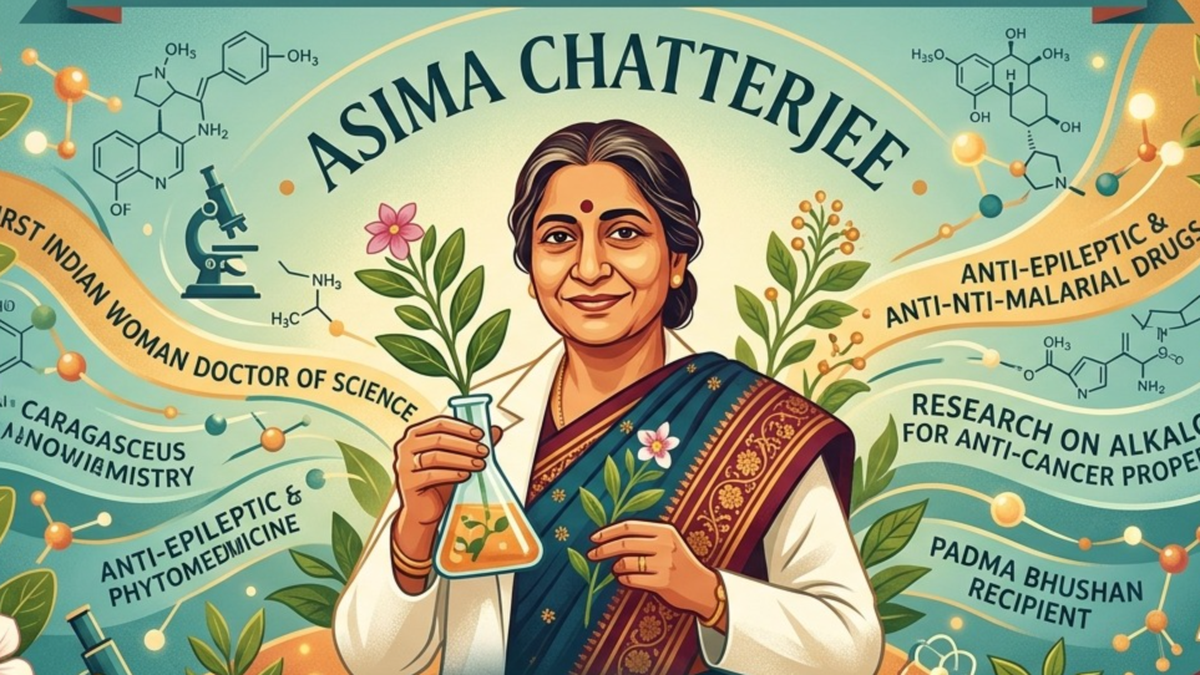
In 1939, Asima Chatterjee, an Indian woman scientist, was born on September 23rd. Born into a time when few women pursued higher education, Chatterjee's passion for chemistry led her to earn a Bachelors and Masters degree in the subject. She then went on to achieve a Doctor of Science degree, making her the first Indian woman to receive this honor from an Indian university.
Chatterjee's expertise in phytochemistry, the study of medicinal properties of plants, led her to work with international experts at the University of Wisconsin, Madison, and the California Institute of Technology. She returned to India with a deep interest in harnessing the potential of India's rich plant biodiversity to develop new drugs.
Chatterjee's most significant contributions include the isolation of chemical constituents from Marsdenia tinctoria, which led to the development of the anti-epileptic drug Ayush-56, and her groundbreaking work on the chemistry of alkaloids in Caranthus roseus, or Madagascar periwinkle, which contributed to understanding compounds with anti-cancer properties.
Beyond her scientific achievements, Chatterjee was also an educator and institution builder, becoming the first woman to hold the prestigious Khaira Professor of Chemistry position at the University of Calcutta. Throughout her career, Chatterjee received numerous accolades, including the Padma Bhushan in 1975, making her the first woman scientist to receive this honor.
She was also the first female recipient of the Shanti Swarup Bhatnagar Prize in Chemical Sciences in 1961 and was awarded the CV Raman Award and PC Ray Award. Chatterjee's work in bridging the gap between traditional Ayurvedic knowledge and modern chemical analysis has paved the way for modern pharmaceutical chemistry and continues to inspire generations of women scientists.
Written by urgent.news from The Hindu - Sci-Tech's reporting — not their text. Machine-written — may contain errors; check the original before relying on it.
Also reported by 1 other outlet
- An Indian woman phytochemist without parallel thehindu.com