Webb telescope captures Black Eye Galaxy in unprecedented detail
Located roughly 17 million light-years from Earth in the constellation Coma Berenices, M64 is known for an unusual internal motion: gas in its outer regions rotates in the opposite direction to the gas and stars closer to the centre. NASA says this counter-rotation may be a remnant of a merger involving M64 and a smaller satellite galaxy more than a billion years ago.
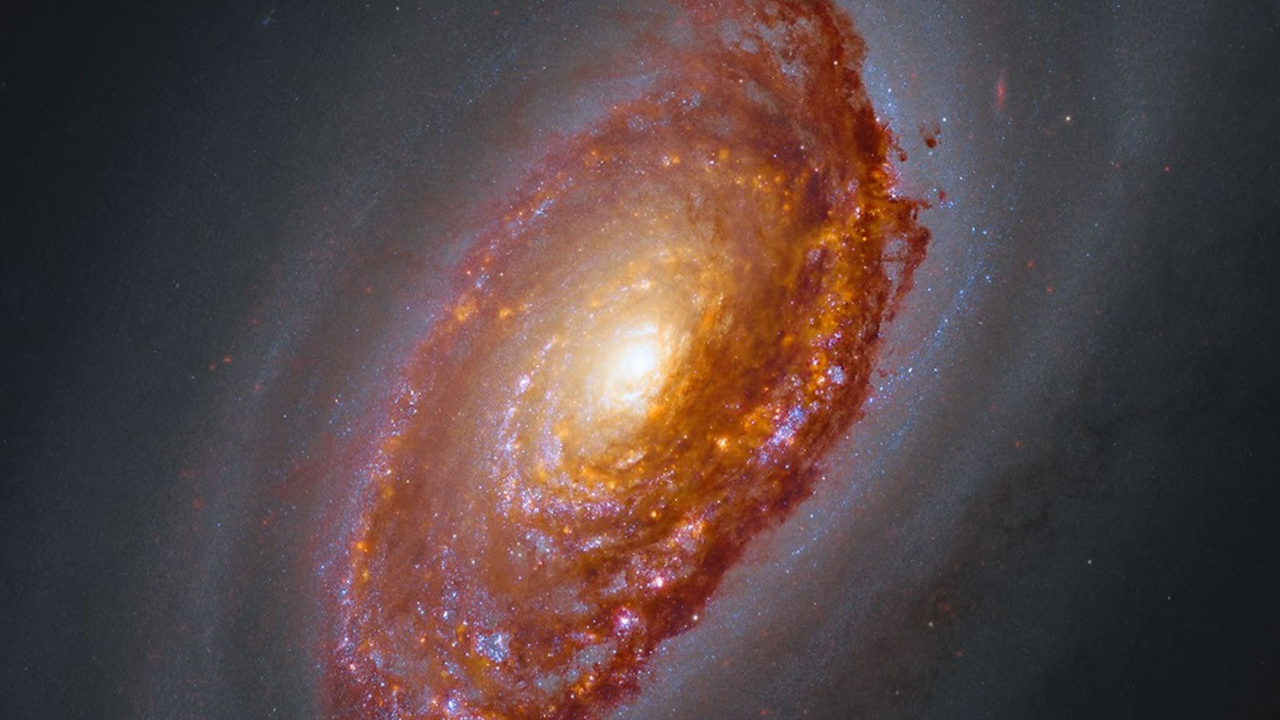
The Black Eye Galaxy, also known as Messier 64, appears in its classic spiral form to the naked eye. Its distinctive dark band, however, conceals a more intriguing story. Located 17 million light-years away in the constellation Coma Berenices, M64 exhibits an unusual internal motion: gas in its outer regions rotates in opposition to the gas and stars nearer the center. This counter-rotation might be a result of a merger with a smaller satellite galaxy over a billion years ago.
NASA's James Webb Space Telescope, working in tandem with the Hubble Space Telescope, has captured unprecedented details of M64 across various wavelengths. The Mid-Infrared Instrument (MIRI) on Webb excels at revealing the dust that appears dark in visible-light observations but emits infrared radiation, including radiation from dust and young stars.
The dark band that gives M64 its nickname is not an empty, shadowy space. Instead, it contains material involved in the continuous formation of new stars. At the heart of M64, gas closer to the center rotates in one direction while gas farther out rotates in the opposite direction. Where these gas systems collide and become compressed, conditions are ripe for the collapse of gas clouds, leading to the birth of new stars.
This galaxy serves as a record of its past merger with a smaller galaxy. Astronomers have studied this phenomenon for decades, with Hubble observations revealing that M64's outer gas extends farther from its center and rotates opposite to the inner gas. The evidence of this ancient encounter lies embedded within the galaxy's unusual gas dynamics, challenging the notion that spiral galaxies' histories are largely peaceful.
The new Webb observations go beyond simply producing a more detailed image. Infrared observations enable astronomers to study the structure, composition, and behavior of dust that is challenging to observe in visible wavelengths. By combining Webb's data with Hubble's view, researchers can gain a more comprehensive understanding of how dust and star-forming regions are distributed throughout M64.
This information will help scientists better comprehend the galaxy's dust and contribute to reconstructing its merger history and evolution.
Written by urgent.news from Times of India's reporting — not their text. Machine-written — may contain errors; check the original before relying on it.