NASA-JAXA XRISM Mission Sees Pulsar Gathering Companion’s ‘Wind’
Using data from the Japan-led XRISM (X-ray Imaging and Spectroscopy Mission) observatory, astronomers have directly observed a giant star’s outflow, called a stellar wind, being captured by its compact companion and providing the power source for strong X-ray flares. The research is part of NASA’s exploration of the extreme universe to better understand how the […]
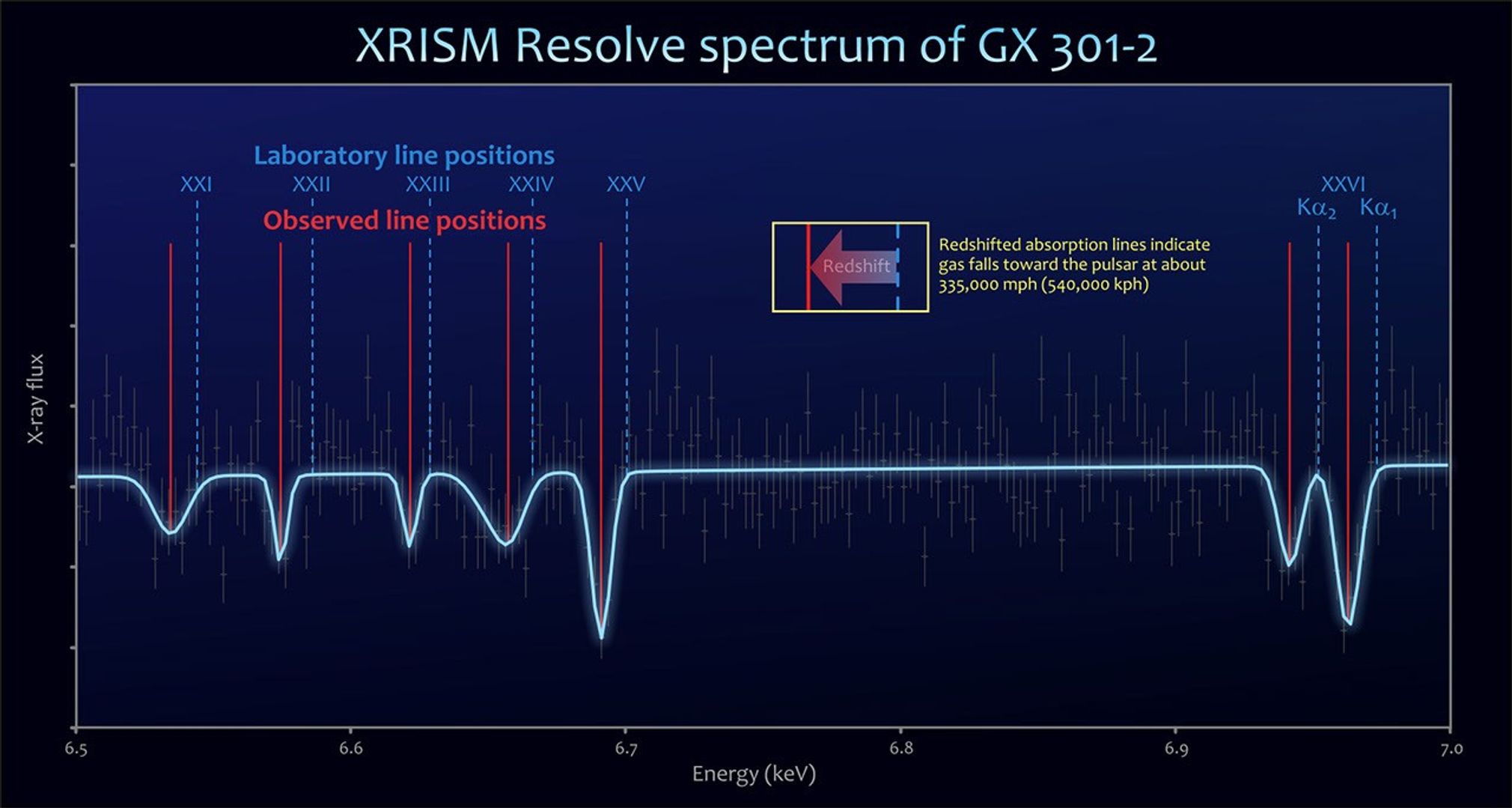
Astronomers have, for the first time, observed a massive star's stellar wind being pulled by its compact companion and powering strong X-ray flares, according to research using data from the Japan-led XRISM (X-ray Imaging and Spectroscopy Mission) observatory. The study, published in the journal Science Advances, offers new insights into the extreme universe and how it functions.
The target system, BP Crucis, is a high-mass X-ray binary located about 13,000 light-years away in the southern constellation Crux. Its primary star, Wray 977, is a blue hypergiant 40 times the mass of the Sun and 60 times its size, constantly emitting a stellar wind. This wind consists of ionized gas that streams away from the star, creating a dense and turbulent region.
The companion of BP Crucis, a neutron star called GX 301-2, is a small but extremely dense object with a mass more than 1.4 times that of the Sun but compressed into a sphere roughly 20 kilometers in diameter. This neutron star rotates every 11 minutes and emits a beam of X-rays that sweeps across Earth, classifying it as a pulsar.
During the pulsar's 41.5-day orbit around the primary star, strong X-ray flares occur near its closest and farthest points from the star. These flares result from the pulsar capturing some of the dense plasma stream created by the stellar wind. The strongest eruptions happen closer to the star, where the plasma stream is denser.
Using the XRISM observatory's Resolve instrument, which captured highly detailed X-ray spectra, researchers observed rapid changes in emission and absorption lines. Particularly, absorption lines from highly ionized iron revealed the speed and direction of the plasma near the pulsar. The gas was found to be moving toward the pulsar at about 335,000 mph (540,000 kph).
This groundbreaking observation allows researchers to test their understanding of these processes more accurately, revealing the complex interplay between the compact object and its stellar companion's wind.
Written by urgent.news from NASA's reporting — not their text. Machine-written — may contain errors; check the original before relying on it.
This story
This is one outlet's version. Read the fullest account.
- NASA-JAXA XRISM Mission Sees Pulsar Gathering Companion’s ‘Wind’ science.nasa.gov