The virtual worlds where robots are trained
Training systems that allow robots to negotiate the real world are getting more sophisticated.
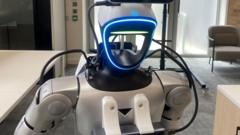
Freddo, a robot, navigates the office and accepts a plastic bottle offered by a staff member. Although this robotic feat does not surpass Usain Bolt's 100m sprint record, the rapid training of Freddo's abilities is noteworthy. In just a few minutes, developers at Vsim, a Cambridge-based start-up, were able to teach Freddo how to walk, identify the bottle, and grasp it.
Rival systems often require days to achieve similar skills. Vsim's founders, Michelle Lu and Kier Storey, envision their software controlling robots that can assist in homes and workplaces. The key to Freddo's speed lies in its virtual environment, where tasks can be repeated millions of times in a computer simulation. Once the optimal solution, or "policy," is identified, it can be uploaded and used by the robot's hardware.
Nvidia, a tech giant, also employs virtual simulations for training robots through its system, Isaac Sim. However, Nvidia's software falls short in providing a comprehensive understanding of the real world, particularly for complex tasks like manipulating objects. In contrast, Vsim's virtual simulation system is faster and more accurate, enabling robots to adapt quickly to unexpected events in dynamic environments.
The start-up, which currently employs 10 engineers, aims to enhance their virtual simulation software and test their models on a second robot named Nacho.
Written by urgent.news from BBC Business's reporting — not their text. Machine-written — may contain errors; check the original before relying on it.