The disconnection of the LHC has begun
The 27 km circumference of the Large Hadron Collider (LHC) contains thousands of magnets of different types – dipoles, quadrupoles, sextupoles, octupoles, decapoles, etc. – which each play a very specific role. Among them are the inner triplets: sets of three quadrupoles (hence the name) located on either side of the four main LHC experiments […]
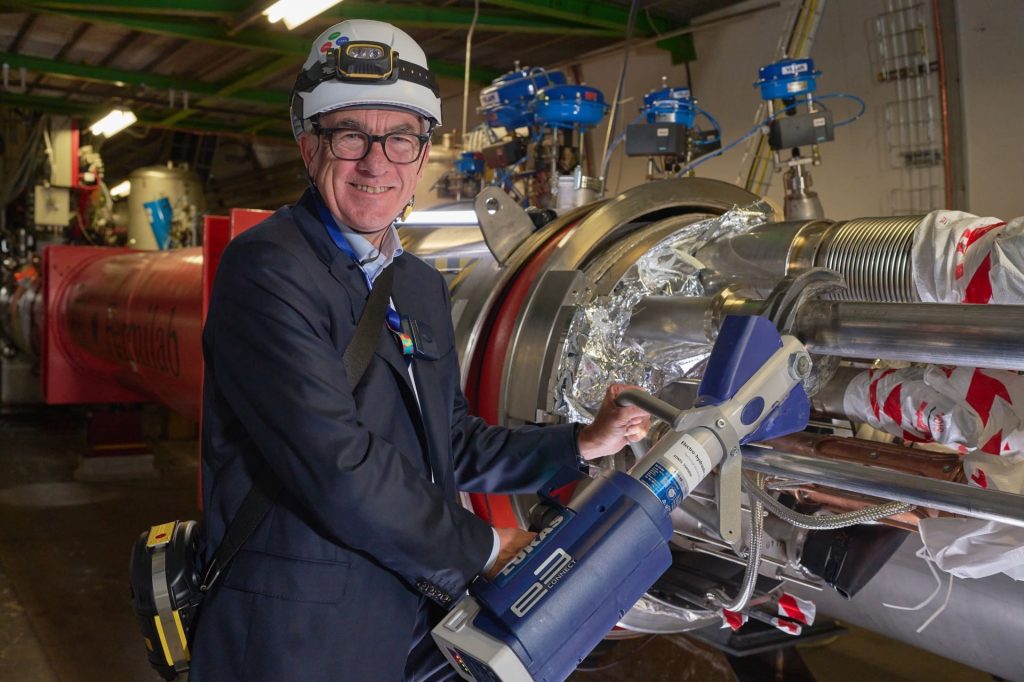
Work has commenced to disconnect the focusing magnets on either side of the ATLAS and CMS experiments at the Large Hadron Collider (LHC), a crucial step towards the upcoming High-Luminosity LHC (HiLumi LHC). CERN Director-General Mark Thomson visited the LHC tunnel to mark the beginning of this dismantling process. The 27 km circumference LHC houses thousands of magnets of various types, including inner triplets consisting of three quadrupoles.
These magnets are essential for focusing the beams before collisions and increasing the luminosity, or number of collisions per unit time. The HiLumi LHC, part of the third long shutdown (LS3), requires the replacement of these inner triplets with more powerful versions. The replacement process involves dismantling 28 superconducting magnets and installing 16 cryostats and 28 cryo-assemblies, a significant undertaking.
The new magnets, with their niobium-tin superconducting coils, will generate magnetic fields 40% stronger than the current magnets, greatly enhancing the LHC's capabilities for the high-luminosity era.
Written by urgent.news from CERN's reporting — not their text. Machine-written — may contain errors; check the original before relying on it.