'No doubt' of climate change role in deadly China-Nepal flood: scientists
Scientists say climate change, glacier retreat and permafrost thaw worsened the Nepal mountain collapse that killed 1,446 people.
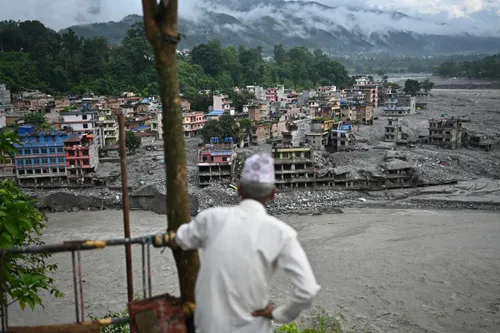
KATHMANDU - Scientists say climate change played a key role in the recent deadly glacial mountain collapse along the China-Nepal border, causing over 1,400 deaths and up to 6,600 people missing. The World Weather Attribution (WWA) group explains the disaster was a "compound crisis" driven by long-term warming, glacier retreat, permafrost thaw, and geological instability.
As the freezing threshold on the Himalayas rises, ice and permafrost near bedrock begin to thaw, weakening slopes, according to a WWA report. On August 26, a massive rock and glacier section broke away from Langtang Lirung mountain, unleashing a flood of water, ice, and debris that swept downstream, destroying communities and infrastructure.
Walter Immerzeel, a mountain hydrologist at Utrecht University, states that the region is undergoing "fundamental, irreversible shifts" due to glacier retreat and permafrost degradation, further destabilizing the mountain. The study also notes that July and August 2026 were the hottest months ever recorded locally, while heavy snowfall in late 2025 led to increased meltwater before the collapse.
Additionally, a magnitude 7.8 earthquake in Nepal in 2015 may have weakened the slope. The reconstruction bill for the disaster is estimated at US$4.78 billion. Prime Minister Balendra Shah will attend the UN General Assembly next week to address the urgent issue of loss and damage due to climate change. According to Nepal's disaster authority, the number of missing people has been revised to 6,150, with 1,403 bodies retrieved, of which 105 have been identified. In China, 43 people are reported dead and 519 missing.
Written by urgent.news from New Straits Times's reporting — not their text. Machine-written — may contain errors; check the original before relying on it.
This story
This is one outlet's version. Read the fullest account.