Koran im Klassenzimmer: Nur wenige Muslime besuchen Islamunterricht in der Schule
Die Teilnehmerzahlen steigen zwar, aber nur ein kleiner Teil muslimischer Schüler besucht den Islamunterricht. Warum das so ist und wie unterschiedlich die Angebote in den Ländern ausfallen.
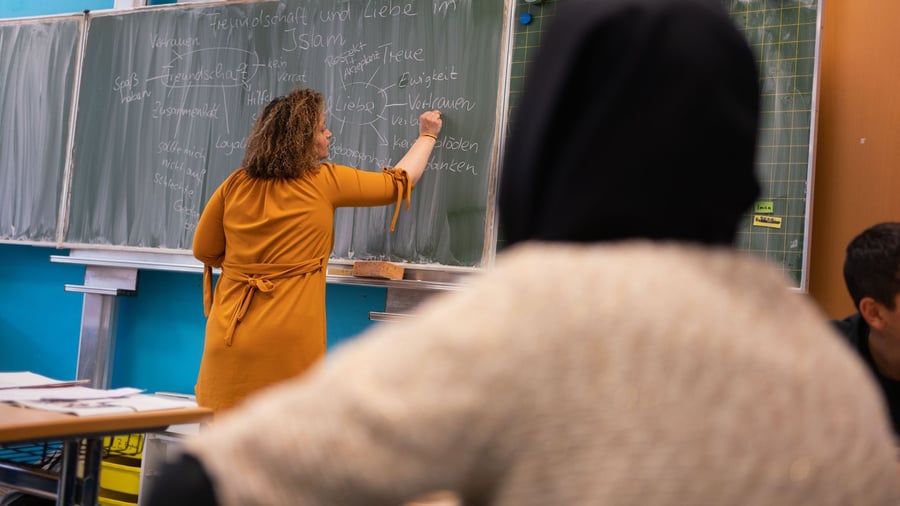
A limited number of Muslim students in Germany attend Islamic religious education classes at school. Research from media service Integration reveals that the number of participants in Islamic education at general schools has roughly doubled since 2015, reaching about 84,000 students. However, this increase does not necessarily mean that the percentage of Muslim students taking such classes has risen.
This is because immigration from refugees, including those from Syria, has also increased the overall number of Muslims living in Germany. According to the Federal Office for Migration and Refugees (Bamf), there were approximately 4.7 million Muslims and Muslim women in Germany in 2015. By the following year, Bamf estimated the number of Muslim residents with a migration background from predominantly Islamic countries to be between 6.6 and 7 million.
Not all regions offer the corresponding Islamic religious education or Islamkunde. In the 2025/2026 school year, confessional-specific Islamic religious education or Islamkunde was offered in nine federal states: Baden-Württemberg, Bavaria, Berlin, Hesse, Lower Saxony, North Rhine-Westphalia, Rhineland-Palatinate, Schleswig-Holstein, and Saarland.
In Bremen and Hamburg, a denominational-free religious education class was provided, which also included Islam. In Saxony, Saxony-Anhalt, Mecklenburg-Vorpommern, Thuringia, and Brandenburg, there is no Islamic religious education. According to the media service, only two percent of Muslim students in Saarland attended Islamic religious education last year.
The figure was seven percent in North Rhine-Westphalia and just under four percent in Lower Saxony. In Bavaria, 15 percent of Muslim students took part in Islamic religious education. This is conducted under state responsibility. In Baden-Württemberg, where around 11,800 students reportedly participated in Islamic religious education last year, the religious content of the classes is managed by the Sunnites' School Council Foundation.
Islamic scholar Mathias Rohe advocates for expanding Islamic religious education. He believes this is necessary, especially in light of Islamic online propaganda. "Islamic religious education can teach children how to counteract it," says the scholar. More positions for Islamic teachers are needed. Statistics on how many Muslim children and teenagers in Germany attend religious education courses at mosques are not available.
Written by urgent.news from Handelsblatt's reporting — not their text. Machine-written — may contain errors; check the original before relying on it.