Huawei debuts 11 AI-related chips in challenge to Nvidia, Intel, AMD
Huawei Technologies is set to unveil its upcoming Ascend 960 AI chips at its annual summit in Shanghai on Thursday, September 17. These new chips, slated for commercial availability in 2027, aim to challenge Nvidia's dominance in the AI chip market and enable Huawei to compete globally, even under US export control curbs. Huawei's chairman, Wang Tao, will present the new components at the event. Analysts will closely monitor whether the Ascend 960 can deliver sufficient power for training frontier AI models.
Chairman Guo Ping of the supervisory board stated that Huawei aims to make its Ascend chips capable of running every AI model, both within China and internationally. The company's supervisory board member emphasized their commitment to innovating chip architectures, drawing a parallel to Apple's success in processor development through architectural redesigns and software optimization.
Huawei has already begun making strides in China and abroad. The company plans to deploy at least 160,000 Ascend 950DT chips in a data center being constructed in Inner Mongolia to support DeepSeek's AI models. Moreover, Huawei is exploring potential markets in Malaysia and Egypt, according to Bloomberg News.
The Chinese tech giant is spearheading Beijing's push for self-sufficiency in critical technologies amid years-long US restrictions intended to hinder China's chipmaking ambitions. Huawei also plays a crucial role in a Beijing-backed initiative to export the Chinese technology stack outside China, as the two global superpowers vie for geopolitical supremacy in various domains.
The upcoming Ascend 960 will succeed the current Ascend 950 family, which already features faster memory for demanding AI inference workloads. Subsequent generations are planned, with each iteration expected to double the computing power of its predecessor.
However, Huawei's AI chips still lag behind Nvidia's leading offerings. Many Chinese AI labs, such as DeepSeek, primarily rely on Nvidia's chips for model training, subsequently utilizing domestic semiconductors for operating the models. This reliance underscores the challenge Beijing faces in completely decoupling from Western technology. At the same time, Nvidia's cutting-edge silicon remains accessible in China through smuggling, albeit in limited quantities.
Furthermore, production capacity constraints also hinder Huawei's ability to meet the growing demand for computing power in China, a market projected to reach 646 billion yuan (US$96 billion) by 2030, according to Morgan Stanley estimates. In response to these challenges, Huawei has employed innovative strategies, including the LogicFolding technique, to enhance its chip technology without relying on the most advanced equipment.
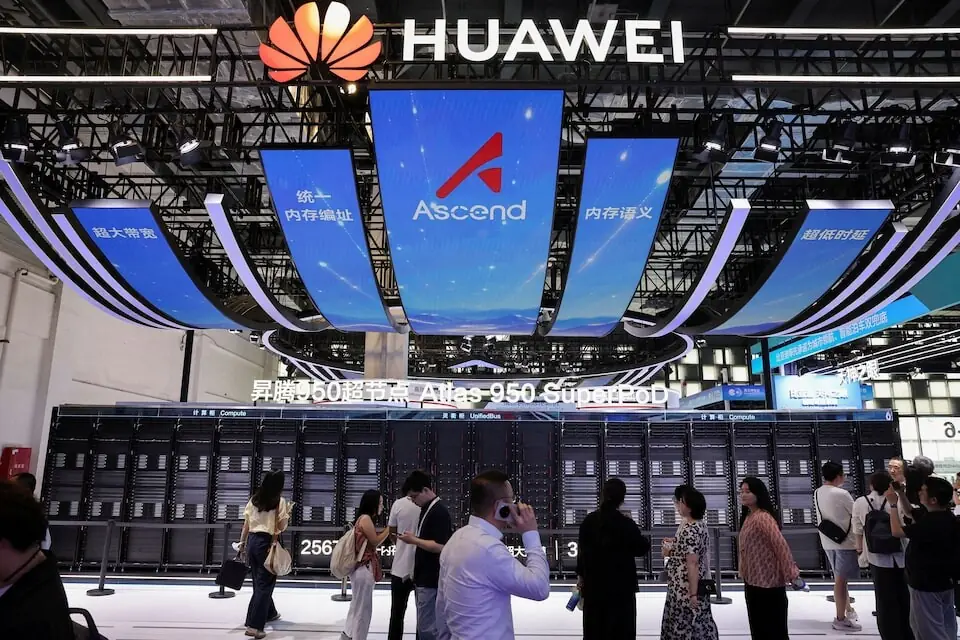
The company has also introduced a SuperPod structure, allowing up to 100,000 Ascend chips to be interconnected in a cluster, which utilizes its UnifiedBus networking protocol to facilitate faster data transmission. Analyst Charlie Chan of Morgan Stanley noted that system-level competitiveness, driven by multi-die design, advanced packaging, rack-scale system architecture, optical networking, and software-hardware co-optimization, is becoming increasingly important in closing the performance gap between Huawei and Nvidia.
Written by urgent.news from The Business Times - Companies & Markets's reporting — not their text. Machine-written — may contain errors; check the original before relying on it.
This story
This is one outlet's version. Read the fullest account.
- Huawei set to unveil China’s best answer to Nvidia AI chip reign businesstimes.com.sg
- Huawei set to unveil China’s best answer to Nvidia AI chip reign straitstimes.com
- Huawei sets 2027 launch for new AI chips as it targets Nvidia freemalaysiatoday.com
- China’s Huawei sets 2027 launch for new AI chips as it targets Nvidia indianexpress.com
- China’s Huawei sets 2027 launch for new AI chips as it targets Nvidia investing.com
- China's Huawei sets 2027 launch for new AI chips as it targets Nvidia economictimes.indiatimes.com
- Huawei unveils latest tech to boost AI power in push to break China’s Nvidia reliance scmp.com
- China's Huawei to launch two new AI chips in 2027 brecorder.com