Deploying a Node App From a Repo on Cloudways Velocity
Learn how to deploy a Node app on Cloudways Velocity
Deploying a Node.js application from a repository directly to Cloudways Velocity is a third option that avoids the complexities and potential issues of running on a bare VPS or using a serverless platform. Unlike those alternatives, deploying from a repository allows the Git history to serve as the source of truth for the production environment. Each commit pushed to the repository becomes a candidate for the next live version, and past commits can be reverted if necessary.
This approach is particularly well-suited for small to moderate workloads. When running a small app on a persistent process, there are no cold starts, pricing remains flat regardless of traffic spikes, and long-lived connections behave as expected. Background tasks like cron jobs or queue workers can also be handled within the same process, eliminating the need for separate functions and deployment pipelines.
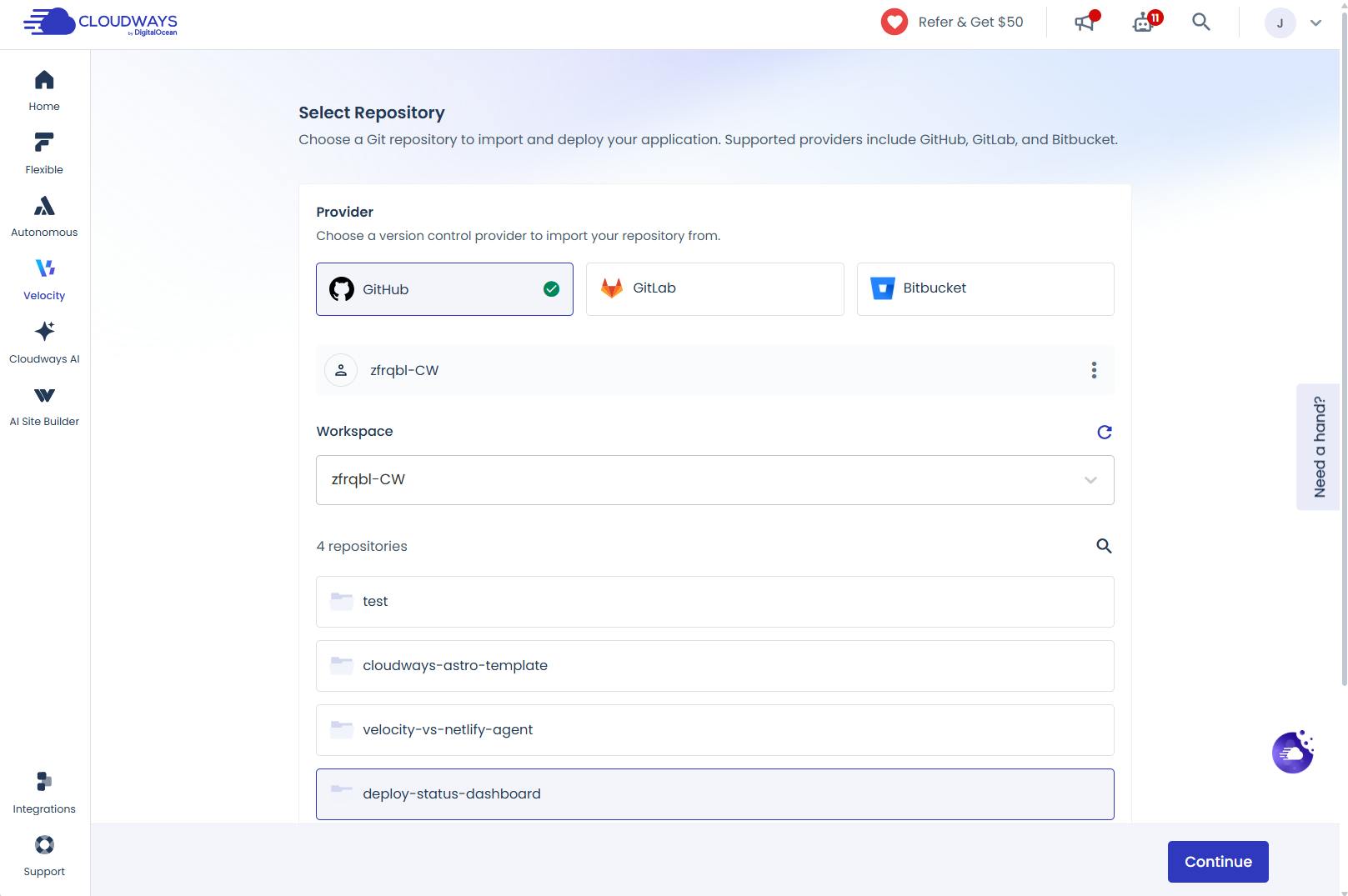
To demonstrate this deployment method, a simple Express app called "Deploy Status Dashboard" was created. The app displays basic information such as the app name, version badge, build information, feature cards, and theme color. The app's code and repository were set up on GitHub, and connecting it to Velocity was a straightforward process within the Cloudways console. Velocity automatically detected the Express framework and Node.js version, eliminating the need for manual configuration.
Upon deploying for the first time, the app displayed the expected results, including the version badge, theme color, and process information. Further changes to the code, such as updating the version number, theme color, and adding a new feature card, were pushed to the GitHub repository. Cloudways Velocity automatically detected these changes and initiated a new deployment, reflecting the updated app instantly.
This deployment method is ideal for projects that require reliability, predictable pricing, and minimal operational overhead. It is particularly well-suited for internal tools, MVPs, small backends, and side projects that need to stay up and running without constant monitoring. However, it may not be the best choice for applications that require deep infrastructure control or operate at a scale where flat pricing is no longer advantageous.
Written by urgent.news from HackerNoon's reporting — not their text. Machine-written — may contain errors; check the original before relying on it.