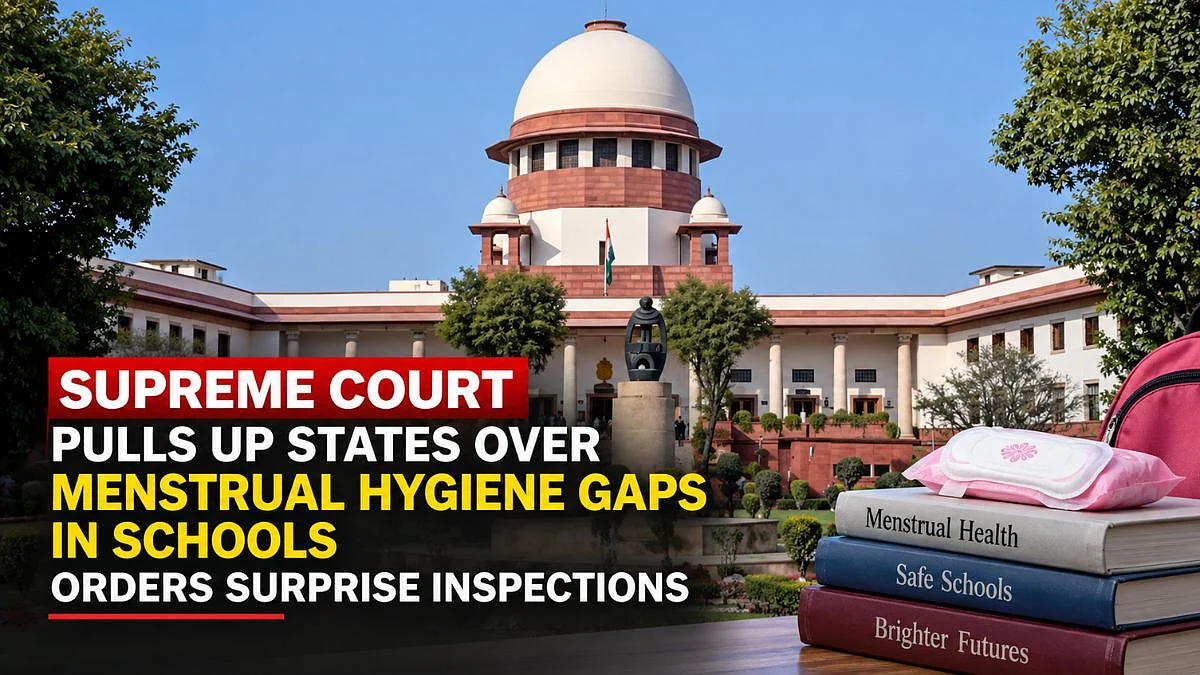
Supreme Court Pulls Up States Over Menstrual Hygiene Gaps In Schools, Orders Surprise Inspections
New Delhi, September 16, 2026: The Supreme Court has expressed dissatisfaction with the way several States and Union Territories have implemented and reported compliance with its directions on menstrual hygiene facilities in schools, saying some responses appeared to be a “mere formality” and showed “non-application of mind”. A Bench of Justices JB Pardiwala and R Mahadevan, while monitoring…
On September 16, 2026, the Supreme Court of India expressed dissatisfaction with the implementation of menstrual hygiene facilities in schools across several states and union territories. The court found that some states' responses to its earlier direction on the issue appeared to be superficial and indicated a lack of genuine effort.
While acknowledging progress, the court emphasized that more needed to be done to ensure the right to menstrual health, which it deemed an integral part of the right to life under Article 21 of the Constitution. The court had previously ordered nationwide implementation of the Menstrual Hygiene Policy for school-going girls from classes 6 to 12, mandating functional gender-segregated toilets, water connections, washing facilities, privacy, accessible toilets for disabled children, free sanitary napkins, hygiene management corners, and waste disposal systems.
During a hearing on September 1, the court highlighted that while substantial progress had been made, mere numerical data did not reflect the true situation. It criticized states for providing "mere formality" or subjective responses, such as statistical claims or simple yes/no answers, rather than substantiating their claims with actual evidence.
The court pointed out discrepancies between reported coverage and the functionality of facilities in several states. For example, Assam's figures for handwashing facilities did not match the total number of schools, and Tamil Nadu claimed saturation of gender-segregated toilets despite having fewer such toilets than its total school count.
The court also questioned claims of sanitary napkin vending machines and provision in Karnataka, Jammu & Kashmir, Odisha, and Arunachal Pradesh, where reported numbers were lower than the total number of schools. Discrepancies were also found in waste disposal data submitted by Bihar, Gujarat, Delhi, Jharkhand, Rajasthan, and Uttar Pradesh. Furthermore, the court expressed concern over Punjab’s illegible report.
The court's scrutiny shifted from administrative claims to the actual functionality and accessibility of facilities for students. It emphasized that merely having a policy or a compliance percentage does not benefit a schoolgirl if the toilet is unusable, water is unavailable, or menstrual products are not readily accessible when needed.
The court's focus now is on identifying the gaps rather than what has already been achieved. Moving forward, states and union territories must report on the specific gaps, such as schools lacking functional gender-segregated toilets, adequate accessibility, privacy, menstrual absorbents, and functioning waste disposal systems. They are also required to explain the reasons for each gap and the time needed to address them.
The court further directed district education officers (DEOs) to conduct surprise inspections of school infrastructure, including toilets, washing facilities, menstrual absorbents, waste disposal, and awareness measures. These inspections should include anonymous feedback from students. DEOs are now mandated to form teams of teachers to carry out these inspections, ensuring a more thorough and accountable assessment of the ground reality.
The court urged states and union territories to work collaboratively with the union government to make the right to menstrual health more meaningful, acknowledging that the progress may be slow but must remain significant and impactful.
Written by urgent.news from Free Press Journal's reporting — not their text. Machine-written — may contain errors; check the original before relying on it.