Securing the Last Mile: Privacy and Compliance in Mobile Payments
Learn how modern mobile payment apps protect user data using encryption, tokenization, biometrics, TLS, secure storage while maintaining compliance.
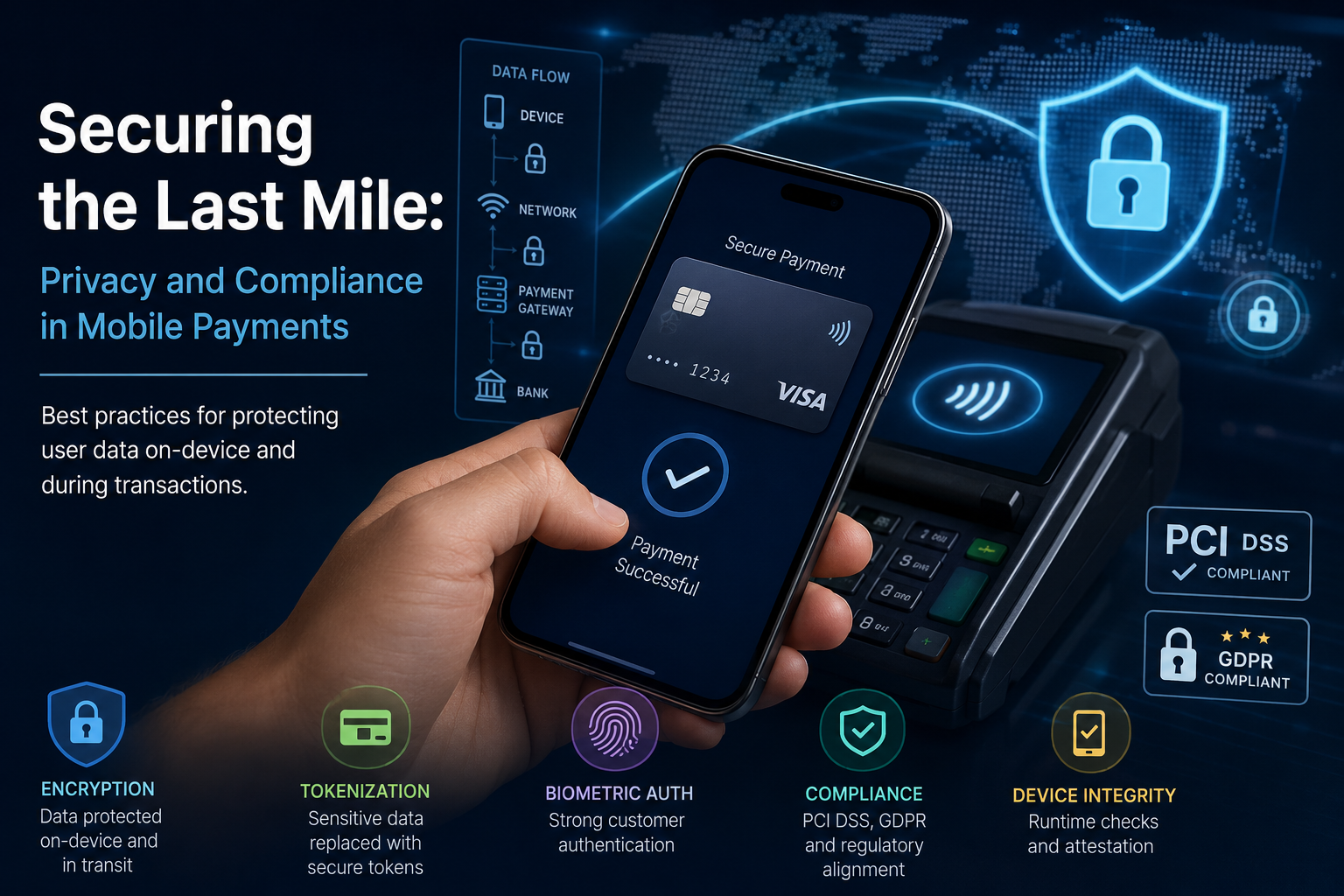
The "last mile" of a mobile payment transaction – the moment sensitive data is processed on the user's device before being sent to a payment terminal or backend – is a crucial point of vulnerability. To protect user privacy and comply with regulations, mobile wallets and payment apps must employ stringent safeguards for on-device data and secure methods for network communication.
Industry best practices mandate end-to-end encryption, tokenization, and adherence to standards such as PCI DSS and data protection laws (e.g., GDPR). PCI DSS specifically emphasizes applying these principles to mobile apps as they would to other payment acceptance endpoints, recommending cryptographic hardening of storage and transit layers, minimal data collection, and privacy-by-design principles.
Mobile platforms provide built-in security features to help achieve these goals. Android's Jetpack Security library, for instance, offers classes like EncryptedSharedPreferences and EncryptedFile that automatically apply AES-GCM encryption backed by the Android Keystore. Similarly, iOS's Keychain and Secure Enclave protect sensitive data.
Storing raw payment card numbers (Primary Account Numbers, PANs) and Card Verification Values (CVVs) is strictly prohibited; instead, tokenization should be used to replace sensitive data with surrogate tokens.
Strong user authentication on the device adds an additional layer of security. Apps should require explicit user intent, such as biometric or PIN confirmation, before authorizing a transaction. Multi-factor authentication approaches further mitigate risks. Critical keys should be marked as Secure Enclave backed to ensure they remain tamper-resistant.
Securing data in transit is equally important. All communication between the mobile app, payment gateway, and backend must utilize TLS 1.2 or higher with robust ciphers and forward secrecy. Connections should only be HTTPS-enabled, and certificate pinning can be employed to safeguard against malicious certificate authorities or man-in-the-middle attacks. Android apps using OkHttp, for example, can pin the host's certificate fingerprint:
```java
CertificatePinner pinner = new CertificatePinner.Builder()
.add("api.payment.example.com", "sha256/AbCdEfGhIjKLmnopqrstuvwxyz1234567890=")
.build();
OkHttpClient client = new OkHttpClient.Builder()
.certificatePinner(pinner)
.build();
Response response = client.newCall(new Request.Builder()
.url("https://api.payment.example.com/charge")
.post(body)
.build())
.execute();
```
Applying these guidelines ensures that interception of payment data in transit becomes highly improbable, complementing the on-device encryption. Tokenization simplifies the last mile by replacing raw card data with opaque tokens throughout the entire process, ensuring the real PAN is never stored on the device.
Written by urgent.news from HackerNoon's reporting — not their text. Machine-written — may contain errors; check the original before relying on it.