NASA’s X-59 Completes 25 Flights as Its Quiet Supersonic Test Approaches
NASA’s X‑59 experimental supersonic aircraft has completed 25 test flights as engineers prepare for the mission’s most important phase: Measuring whether its unusual design can replace the disruptive sonic boom with a quieter “sonic thump.” The Lockheed Martin–built aircraft reached its 25th flight on Aug. 21, taking off from NASA’s Armstrong Flight Research Center in […]
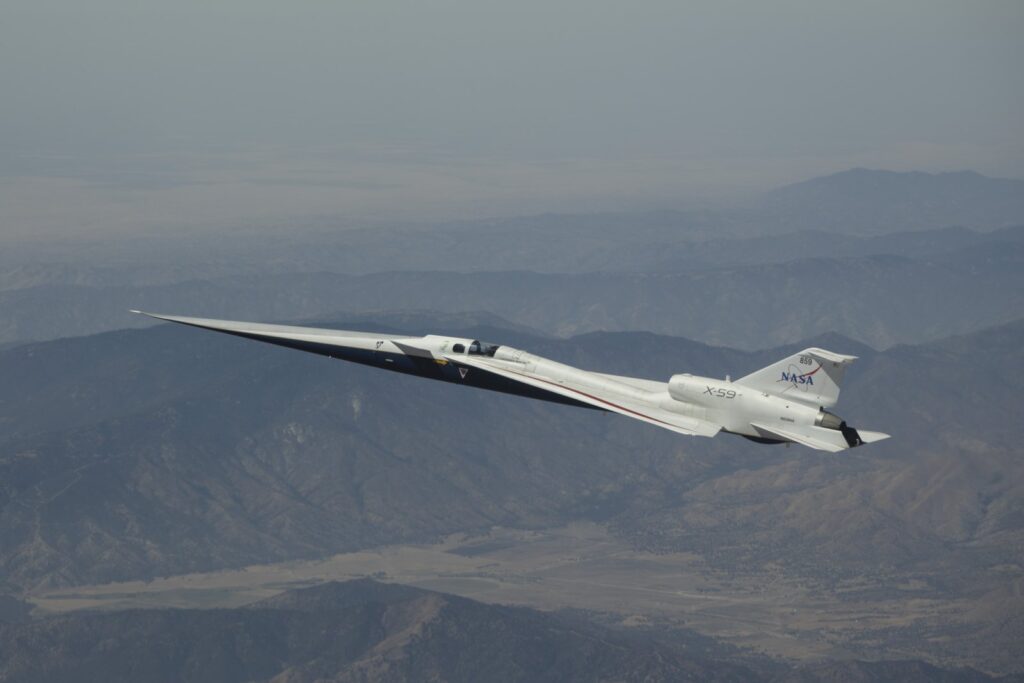
NASA's X-59 experimental supersonic aircraft has successfully completed 25 test flights, paving the way for its most crucial phase: measuring whether its unique design can replace the disruptive sonic boom with a quieter "sonic thump." The Lockheed Martin-built aircraft reached its 25th flight on August 21, soaring from NASA's Armstrong Flight Research Center in Edwards, California.
During a 72-minute flight, the X-59 achieved Mach 1.2 (1.481 km/h) and reached approximately 49,000 feet (14,935 meters) altitude. Engineers have found that the aircraft's real-world flight characteristics closely align with predictions from computer models, wind-tunnel testing, and other analyses. However, the 25 flights have primarily established performance and expanded flight envelope, without yet completing the acoustic testing that will determine if the X-59 can deliver the quieter supersonic flight its designers envisioned.
The X-59 is at the heart of NASA's Quesst mission, a research program aimed at gathering data to potentially make commercial supersonic flight over land possible again. By carefully shaping its fuselage, wings, and engine placement, the aircraft aims to spread and manage shock waves generated at supersonic speeds, resulting in a softer sound that reaches the ground.
During the X-59's initial supersonic flight on June 5, test pilot Jim Less reached about Mach 1.1 at 43,400 feet (13,228 meters) altitude. Later, on June 12, the X-59 successfully reached supersonic conditions of Mach 1.4 (924 mph or 1,487 km/h) at 55,000 feet (16,764 meters), which will be the baseline for future community flights to collect data on how people perceive the aircraft's sound.
The aircraft is powered by a single General Electric F414-GE-100 engine, capable of propelling the X-59 to Mach 1.4 and an altitude of about 55,000 feet. The 25 flights have validated that several key aspects of the X-59 behave as predicted, including its flying qualities, stability margin, and flight loads, all of which have closely matched simulations.
The aircraft has also demonstrated stability and avoided unexpected aerodynamic issues. However, the 25 flights have primarily focused on performance and flight envelope expansion, leaving out the crucial acoustic testing to validate the "sonic thump" concept. Upcoming acoustic validation flights are expected later this year, once the X-59 completes final checkouts and the ground-instrument network is in place.
These tests will determine if the pressure waves reaching the ground create the intended quiet thump. The data gathered from these tests will help establish noise-based rules for commercial supersonic flight over land, potentially influencing future regulations.
Written by urgent.news from Colombia One's reporting — not their text. Machine-written — may contain errors; check the original before relying on it.