Webb reveals stunning panorama of star formation
This starry view of the nearby star-forming region IC 348 is one of the largest images from the NASA/ESA/CSA James Webb Space Telescope released to the public so far. Using Webb, astronomers searched IC 348 for brown dwarfs, which are less massive than the smallest stars. The researchers discovered brown dwarfs just twice the mass of Jupiter, bringing the study of these curious objects into a new…
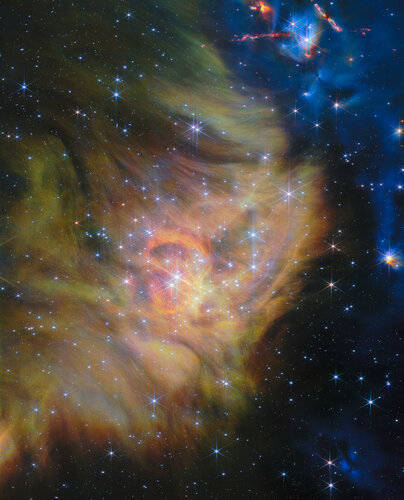
A stunning panorama of star formation has been revealed by the James Webb Space Telescope, showcasing a nearby star-forming region called IC 348. Located just 1,000 light-years away in the constellation Perseus, IC 348 is a cold cloud of molecular hydrogen gas that collapses to form new stars, resulting in breathtaking, sculpted scenes.
Using Webb's sensitive instruments, astronomers discovered brown dwarfs with masses as low as twice the mass of Jupiter, marking the smallest objects ever found to be created by the star-formation process. These ultra-lightweight brown dwarfs challenge existing models of star formation and raise questions about the smallest possible brown dwarfs that can form.
In addition to the brown dwarfs, the Webb observations revealed a collection of protostars, some accompanied by luminous Herbig-Haro objects. These objects form when jets from growing newborn stars collide with the surrounding gas and dust. The data for this image came from Webb's observing program #4866, which aimed to study the lowest-mass objects created through the star-formation process, understand the variability of planetary-mass objects like brown dwarfs in different star-forming regions, and probe the origins of hydrocarbon features in the lowest-mass brown dwarfs.
Written by urgent.news from ESA Space Science's reporting — not their text. Machine-written — may contain errors; check the original before relying on it.
This story
This is one outlet's version. Read the fullest account.
- NASA’s Webb Reveals Dynamic Panorama of Star Formation science.nasa.gov