Trump’s Position on AI Makes No Sense
If the president is so concerned about staying ahead in the AI race, why is he letting Chinese companies buy American chips?

The AI arms race is a hot topic, with tech leaders urging governments to slow down. However, President Donald Trump is not on board with the idea. In a recent interview, he dismissed calls for AI regulation, stating that doing so would cede America's position in the global AI race. "We're leading China in AI," Trump told reporters, emphasizing that the U.S. should maintain its lead.
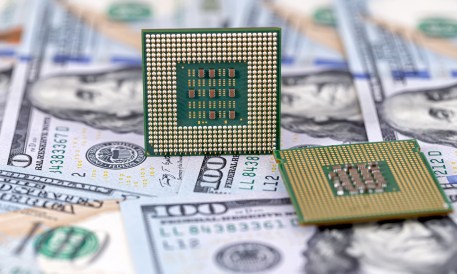
He even labeled calls for regulation as a "SICK conspiracy" in a recent post on Truth Social, accusing China of being the only party benefiting from such efforts. Despite Trump's concerns over staying ahead of China in the AI race, his administration's recent policies have had the opposite effect. Late last year, the administration lifted export controls on advanced chips from Nvidia, a crucial input to AI development.
This move essentially allowed the U.S. to maintain its lead over China in AI by ensuring that it had access to highly advanced computer chips capable of performing trillions of calculations per second. Experts believe that China is currently level with or even ahead of the U.S. in terms of engineering talent, training data, and energy supply.
However, AI model training requires highly advanced computer chips, and Nvidia is the only company globally capable of producing such chips at scale. In October 2022, the Biden administration imposed export controls on Nvidia chips sold to China, aiming to slow down China's AI development by withholding this crucial resource. When Trump took office in January 2025, the policy seemed to be working, with American AI models estimated to be ahead of Chinese models.
However, Trump began loosening the restrictions over the course of 2025. He halted the implementation of a Biden-era rule on preventing Nvidia chips from being smuggled into China, lifted controls on the sale of Nvidia's H20 chip, and removed the ban on the more powerful H200 chip. Chinese companies have indeed begun to catch up since these controls were lifted, with multiple Chinese AI firms releasing models performing nearly as well as top U.S. models at a fraction of the cost.
Experts now believe that the AI gap between the U.S. and China is about six months and closing fast. While Trump may be right that a unilateral AI slowdown could create a serious risk of the U.S. being overtaken by China, he argues that the solution is not a perpetual, unrestricted AI arms race. Instead, he advocates for a mutual deceleration of AI progress through a nonproliferation agreement with China.
Written by urgent.news from The Atlantic's reporting — not their text. Machine-written — may contain errors; check the original before relying on it.